

 InfoSearched
Every network engineer eventually has to carve up a /24 block, and Sunny Cafe is where a lot of them learn how.
“Subnetting Is Simple,” the 13-minute-33-second tutorial YouTuber Sunny Classroom posted on March 31, 2018, turns a routine CompTIA Network+ exercise into a coffee shop story. A supervisor hands a technician the Class C network ID 192.168.4.0/24 and tells them to slice it into three physical zones for Sunny Cafe: the back office, the front desk and storage room, and public Wi-Fi. From there the lesson escalates into a full 6-subnet build-out that walks through every host range, broadcast address, and wasted block along the way.
- The original task requires three subnets from 192.168.4.0/24, solvable by borrowing 2 bits (2² = 4 subnets) with room to spare.
- The extended practice problem asks for 6 subnets from the same block, which forces borrowing 3 bits (2³ = 8 subnets), shifting the mask from /24 (255.255.255.0) to /27 (255.255.255.224).
- Each of the 8 resulting subnets carries a block size of 32 and yields exactly 30 usable host addresses, leaving 2 of the 8 subnets completely unused once the 6-subnet requirement is met.
The Coffee Shop Scenario
Sunny Classroom frames the math around a situation any small business network actually resembles: separate the back-office machines, the point-of-sale and storage devices at the front desk, and the customer-facing Wi-Fi so none of them can see each other’s traffic. Borrowing 2 host bits from the /24 gives four subnets, more than enough to cover the three zones with one to spare for expansion. That’s the version of subnetting most viewers meet first — small, borrow the minimum, move on.
The video doesn’t stop there, though, which is what separates it from a quick how-to and makes it useful reference material for anyone studying for Network+. It pushes the same 192.168.4.0/24 block into a harder problem: what happens when the requirement isn’t three subnets, but six.
Borrowing Three Bits for Six Subnets
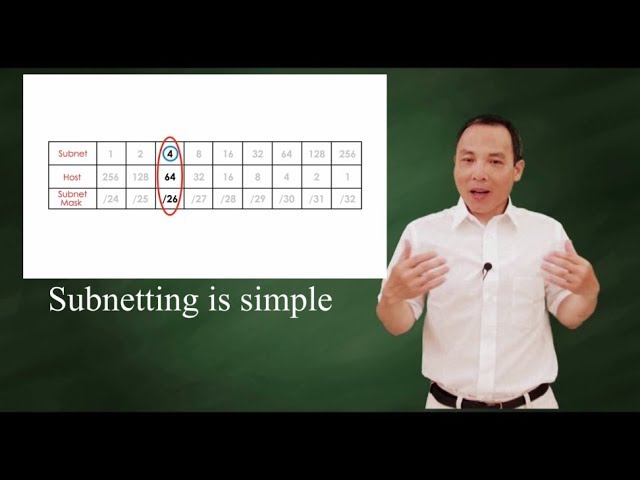
Six subnets can’t be produced by borrowing 2 bits — that formula (2²) caps out at four. The tutorial shows why the next step up, borrowing 3 bits (2³), is mandatory even though it only strictly needs six: 3 bits is the smallest number that clears the six-subnet bar, and it produces 8 total subnets as a byproduct. That shift moves the subnet mask from the default /24 (255.255.255.0) to /27 (255.255.255.224), taking 5 bits with it for host addressing.
With 5 host bits remaining, the formula 2⁵ − 2 leaves 30 usable host IDs per subnet, and the block size — the increment separating each subnet’s starting address — comes out to 32. Sunny Classroom lays out the full table:
- Subnet #1: network ID 192.168.4.0, usable range 192.168.4.1–192.168.4.30, broadcast 192.168.4.31
- Subnet #2: network ID 192.168.4.32, usable range 192.168.4.33–192.168.4.62, broadcast 192.168.4.63
- Subnet #3: network ID 192.168.4.64, usable range 192.168.4.65–192.168.4.94, broadcast 192.168.4.95
- Subnet #4: network ID 192.168.4.96, usable range 192.168.4.97–192.168.4.126, broadcast 192.168.4.127
The pattern repeats in 32-address jumps all the way to Subnet #8, which starts at 192.168.4.224, runs from .225 through .254, and broadcasts on .255.
The Waste Every FLSM Design Accepts
The closing question in both parts of the exercise is the one that actually tests whether a student understands the concept rather than just the arithmetic: how many subnets get wasted. Building for exactly 6 subnets under a fixed-length subnet mask scheme still generates 8, because 3 borrowed bits is the smallest power of two that satisfies “at least 6.” That leaves 2 subnets sitting unused — allocated address space with no zone assigned to it.
Borrow 3 bits, get 8 subnets, need 6 — the other 2 just sit there wasted, and that’s the whole point of the lesson.
That’s the tradeoff baked into fixed-length subnet masking: every subnet in the design gets the same mask and the same 30-host ceiling, whether it’s the back office with five workstations or public Wi-Fi with fifty customers on a Saturday morning. Anyone studying this pattern for Network+ or working through similar drills on network technology fundamentals will recognize the same wasted-subnet math showing up on exam after exam, because it’s the tradeoff every FLSM design makes by default.
Exam Results Influence Future Success
The Sunny Cafe example works precisely because it’s small enough to hand-calculate but structured exactly like problems technicians hit in production: a NOC team segmenting VLANs by department, a retail chain isolating point-of-sale traffic from guest internet, or an office splitting departments for security policy enforcement. The same borrowing logic that separates the back office from public Wi-Fi in this tutorial is what a network engineer applies when isolating sensitive systems on a live network, the kind of hands-on troubleshooting covered in A DAY (NIGHT) in the LIFE of a NOC ENGINEER!.
Sunny Classroom doesn’t dress this up with anything beyond a whiteboard and a coffee shop story, and that’s the appeal — the six-subnet answer key, with its 2 wasted blocks, is the exact kind of question that shows up verbatim on Network+ practice exams, so anyone bookmarking the video for study purposes should be ready to redo the 3-bit borrow from memory before test day.



Beyond bionics: how the future of prosthetics is redefining humanity
9 AMAZING NEW GADGETS YOU CAN BUY ON AMAZON AND ONLINE
Goodbye Silicon! Your Next Computer Chip Could Be Made of Gallium Oxide
5 NEW Inventions 2019 | That Will Blow Your Mind
10 OF THE COOLEST MEANS OF TRANSPORT