

 InfoSearched
Finland is about to bury nuclear waste for 100,000 years and call the problem solved.
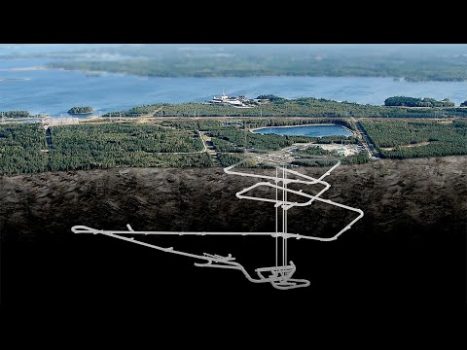
While most of the nuclear industry has spent decades arguing about where to put spent fuel, Finland just started digging the answer. On the Olkiluoto peninsula in Eurajoki, engineers are boring hundreds of meters into granite bedrock that formed 1.9 billion years ago, building the first permanent, licensed repository for high-level nuclear waste anywhere in the world.
- Posiva Oy’s Onkalo repository sits 400 to 450 meters underground in ancient crystalline granite at Olkiluoto, western Finland.
- The KBS-3 method — developed with Sweden’s SKB — packs spent fuel into cast-iron inserts, seals them in copper canisters, and buries them in bentonite clay designed to hold for at least 100,000 years.
- In May 2021, Posiva began excavating the first final disposal tunnels, with operations targeted for the mid-2020s.
The Onkalo Repository Takes Shape
Finland is simultaneously finishing Olkiluoto 3, set to become Europe’s most powerful nuclear reactor, and solving the waste problem that has stalled nuclear buildouts everywhere else. The Onkalo complex pairs an above-ground encapsulation plant — construction started in mid-2019 — with an underground tunnel network cut into bedrock chosen specifically because it hasn’t shifted in nearly two billion years. That geological stability is the entire premise: rock this old and this dry moves waste out of human timescales and into geological ones.
Other countries have tried and stalled. Site selection fights, political reversals, and decades of interim storage have left most of the world’s spent fuel sitting in cooling pools and dry casks at reactor sites, waiting on a permanent home that never arrives. Onkalo is different because it’s no longer a proposal — it’s an active excavation with a construction timeline.
Inside the KBS-3 Barrier System
The engineering is layered by design, not chance. Spent fuel rods go into nodular cast-iron inserts, which are sealed inside thick copper canisters chosen for their corrosion resistance. Those canisters are then set into deposition holes lined with waterproof bentonite clay, which swells to seal any gaps, and the surrounding tunnels are backfilled with more clay.
Even if a canister or the rock around it were ever breached, the waste is designed to stay put and dissolve harmlessly into the surrounding clay and rock rather than migrate.
It’s the same multi-barrier logic behind other engineered environmental fixes — redundancy stacked on redundancy so no single failure point determines the outcome. Readers who followed Finland’s approach to energy storage broadly might recognize the same philosophy at work in projects like Power to Gas, a future energy solution to store renewable electricity, where multiple conversion steps exist to make the whole system fail-safe rather than fail-prone.
From Legislation to Excavation
The legal groundwork goes back to 1994, when Finland amended its Nuclear Energy Act to ban importing or exporting nuclear waste — forcing the country to solve its own disposal problem rather than ship it elsewhere. Posiva was founded in 1995 by power companies TVO and Fortum specifically to manage that obligation, and the company has spent the years since refining the KBS-3 concept alongside Sweden’s SKB.
That May 2021 milestone — the start of excavation on the first final disposal tunnels — is the clearest sign yet that Finland has moved past study phases and site debates into construction. Posiva is now working toward operational readiness by the mid-2020s, a timeline no other country pursuing deep geological disposal has managed to hit.
Global Implications Beyond Finland
Nuclear power’s expansion has always run into the same wall: even supporters struggle to explain what happens to the fuel after it’s spent. Onkalo doesn’t just answer that for Finland — it gives every other country weighing new reactors, including the pitch around projects tied to how close we are to fusion energy as a longer-term alternative, a working template for the fission waste problem that fusion research is ultimately trying to sidestep altogether.
For now, fission is what’s actually generating power, and Finland just proved the back end of that equation is solvable with existing engineering rather than a hypothetical breakthrough.
Posiva’s own targets put final disposal operations starting in the mid-2020s, once Onkalo’s tunnel network is far enough along to start receiving canisters from the encapsulation plant. If that schedule holds, Finland won’t just be running Europe’s most powerful reactor at Olkiluoto — it’ll be the only country on earth actually burying its spent fuel for good instead of just talking about where to put it.


DEMA SHOW 2019: The One New Scuba Gear Everyone Is Talking About!
The danger of AI is weirder than you think
10 SECRET Military Technologies
New technology makes troops invisible
The Five Laws of Cybersecurity | Nick Espinosa | TEDxFondduLac