

 InfoSearched
Inside D-Wave’s Burnaby lab, a YouTuber gets hands-on with a machine that runs colder than deep space.
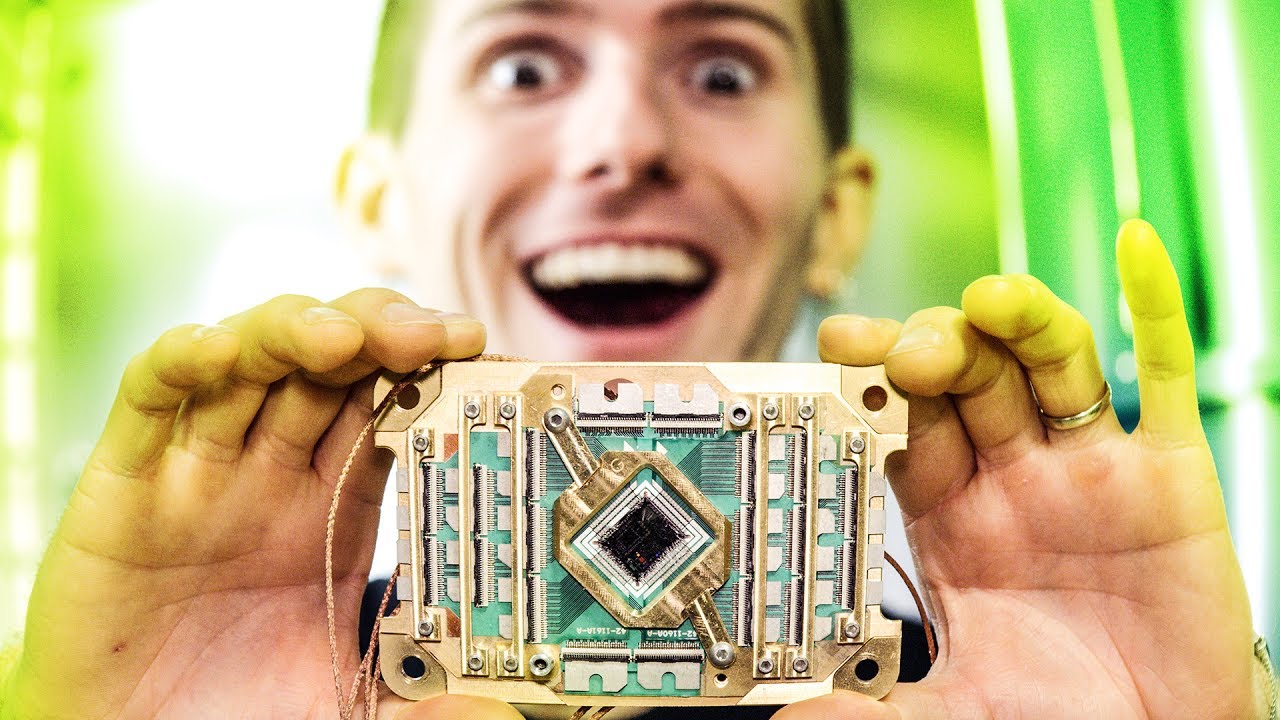
Linus Sebastian has torn down gaming rigs, overclocked servers until they screamed, and crammed enough hardware into a single video to make most PC builders jealous. But in July 2017, the Linus Tech Tips host walked into something built on a completely different set of physics. “UNBOXING A QUANTUM COMPUTER! – Holy $H!T Ep 19” takes Sebastian to D-Wave Systems’ headquarters in Burnaby, British Columbia, where the commercial quantum computing company let him climb inside the guts of one of its quantum annealing systems.
- The episode is part of Linus Tech Tips’ recurring “Holy $H!T” series, hosted by Linus Sebastian, not a physicist-led unboxing as some later descriptions of the video have claimed.
- D-Wave’s system runs inside a 10-foot-tall black enclosure that houses dilution refrigeration hardware chilling the quantum processing unit (QPU) to roughly 15 millikelvin — colder than deep space.
- The tour draws a clear line between D-Wave’s quantum annealing hardware, built for combinatorial optimization problems, and universal gate-model quantum computers that run arbitrary quantum algorithms.
Sebastian’s Key Tour Discoveries
There’s no cardboard box and no packing foam here — the “unboxing” premise is really an excuse to get a camera past D-Wave’s front desk and into the room where the hardware lives. D-Wave staff walked Sebastian through the physical construction of the annealer layer by layer, stripping back the exterior frame of a system that costs in the multimillions of dollars to reveal the wiring, shielding, and cryogenic chambers underneath.
The centerpiece is the black enclosure itself, roughly ten feet tall, which exists almost entirely to protect the tiny chip at its core from the outside world. Everything inside is engineered to keep the QPU isolated from thermal noise, stray magnetic fields, and radio-frequency interference that would otherwise wreck the delicate quantum states the processor depends on.
Cold Enough to Beat Deep Space
The number that anchors the whole video is 15 millikelvin — a fraction of a degree above absolute zero, and colder than the ambient temperature of outer space itself. D-Wave’s dilution refrigerators have to hit that mark and hold it steady, because the superconducting qubits inside the QPU only behave the way quantum mechanics predicts when they’re isolated from ordinary heat.
15 millikelvin — colder than deep space, and that’s before you even get to the part where the wiring and shielding have to keep the chip that quiet, too.
Sebastian and the D-Wave team spend a good chunk of the episode on that refrigeration stack, since it’s arguably a bigger engineering feat than the chip itself. Readers who want the broader physics of why cold matters this much for computing can find a plainer breakdown in this beginner’s guide to quantum computing.
Annealing Versus Gate-Model: The Distinction That Matters
The episode also does some myth-busting that’s easy to skip past if you don’t know the field. D-Wave doesn’t build general-purpose quantum computers that run arbitrary code the way a gate-model machine does. Instead, its systems are quantum annealers, purpose-built to search for the lowest-energy solution to a specific class of combinatorial optimization problems — think scheduling, routing, or logistics problems with enormous numbers of possible configurations.
That’s a meaningfully different animal from the universal gate-model quantum computers that dominate most headlines, which use logic gates to execute any quantum algorithm you throw at them. Conflating the two is a common mistake, and the D-Wave staff use Sebastian’s tour to correct it on camera, walking through exactly what their hardware is — and isn’t — built to do. For viewers chasing the hardware side of this comparison further, the channel’s own look at chip-level physics in The Extreme Physics Pushing Moore’s Law to the Next Level covers similar ground on where conventional silicon starts to hit its limits.
By the time the camera pulls back out of the cryogenic chamber, Sebastian’s gotten further inside a working quantum annealer than most tech channels ever get near — no lab coat, no physics degree, just a Canadian company willing to open the enclosure for a YouTuber with a camera crew.





This researcher created an algorithm that removes the water from underwater images
This Man Launched a New Internet Service Provider from His Garage | Freethink DIY Science
How Close Are We to Fusion Energy?
Tesla Earthquake Machine [3D Printed]
New Free internet 100% – New Technology Free internet 2019