

 InfoSearched
Two grape halves in a microwave shouldn’t be able to make fire — and yet they do.
Derek Muller, the physicist behind Veritasium, spent a video in February 2019 taking apart one of the internet’s favorite kitchen tricks: slice a grape almost in half, leave a thin strip of skin holding the two halves together, toss it in the microwave, and watch a ball of glowing plasma erupt where the halves touch. The trick is real. The explanation that’s been floating around YouTube for years, Muller found, is not.
- A 2019 study in the Proceedings of the National Academy of Sciences, authored by Hamza Khattak, Pablo Bianucci, and Aaron Slepkov, disproved the popular idea that a thin bridge of grape skin acts as a conducting antenna.
- Water inside a grape has a dielectric constant that gives it a refractive index of roughly 10 in the microwave spectrum, slowing microwaves to about one-tenth of their free-space speed — shrinking their wavelength from roughly 12 cm to about 1.2 cm, almost exactly the diameter of a grape.
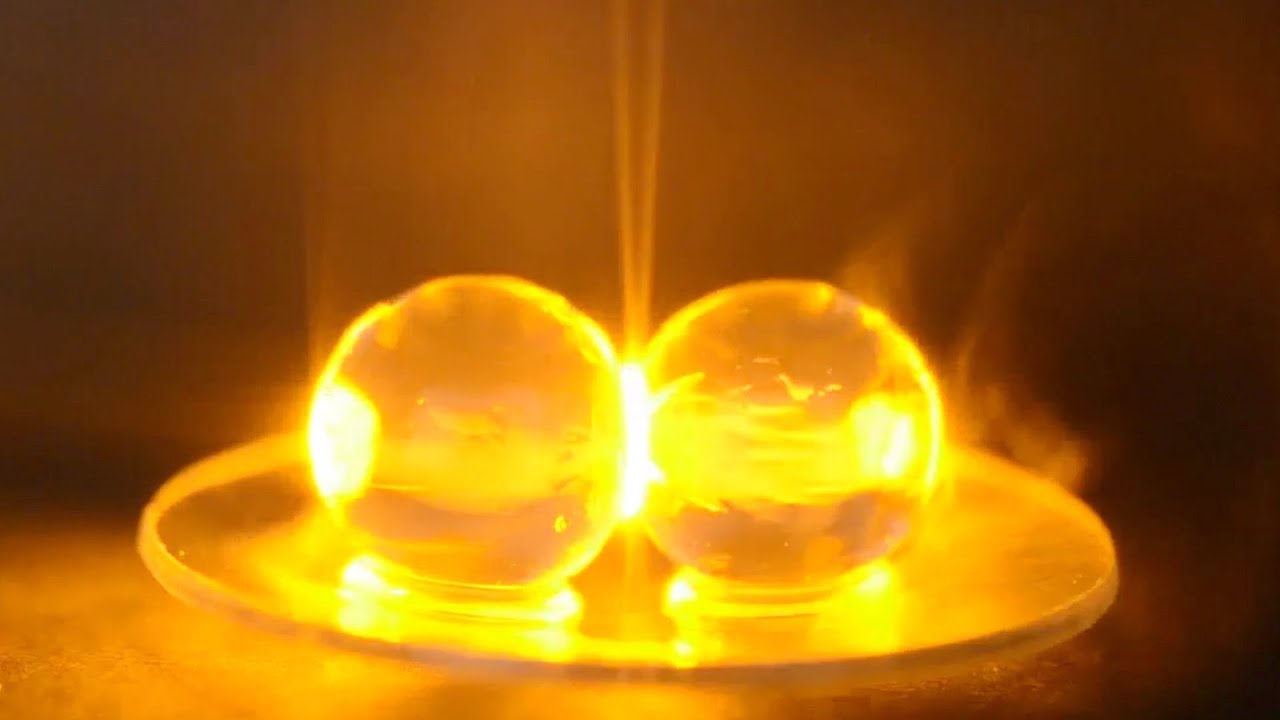
- Veritasium reproduced the plasma effect with whole grapes set side by side, large gooseberries, quail eggs, and salt-water-soaked hydrogel beads — proving the skin bridge was never necessary at all.
The Antenna Theory That Wasn’t
For years, the standard explanation for grape plasma involved that little strip of skin left connecting two halves after slicing. The theory held that the skin behaved like a tiny wire, carrying electric current between the two grape halves until it heated up and ignited. It’s an intuitive story — and according to the PNAS paper by Khattak, Bianucci, and Slepkov, it’s wrong.
Muller walks through their findings and their own tests, showing that the skin bridge isn’t doing the electrical work everyone assumed. The actual mechanism has nothing to do with a conductive strip and everything to do with how a grape’s water content behaves inside a 2.45 GHz microwave cavity — the same frequency every household microwave runs on.
Optimal Size of the Grape
The real explanation is dielectric resonance. Water’s refractive index of around 10 in the microwave band means microwaves traveling through the grape’s watery interior slow down dramatically, compressing their wavelength to roughly 1.2 cm — which happens to closely match the diameter of an average grape. That near-perfect match turns each grape half into a resonant cavity, trapping electromagnetic energy inside it rather than letting it pass through.
Water’s refractive index of about 10 in the microwave spectrum slows the waves to roughly one-tenth of their normal speed — just enough to make a grape resonate at exactly the wrong (or right) size.
When two of these resonating spheres are pushed together, their trapped fields couple at the point of contact, stacking energy into an incredibly small, incredibly hot spot. That concentrated field is intense enough to vaporize potassium and sodium ions sitting in the grape’s tissue, stripping electrons off them and forming the glowing arc of ionized gas anyone who’s tried this at home has seen shoot up out of the microwave.
Testing It Without the Skin Bridge
To prove the skin bridge is irrelevant, Muller repeated the demonstration using two separate, uncut grapes placed right next to each other — no connecting tissue of any kind — and got the same plasma fireball. He then pushed the experiment further, swapping in large gooseberries and quail eggs, and finally synthetic hydrogel beads: water-polymer spheres soaked in salt water with no biological structure whatsoever.
Every pairing that matched the right size and water content produced the same result. That’s the kind of systematic, repeatable testing that separates a real physics explanation from a viral kitchen legend, and it’s a habit Muller leans on across his channel — the same rigor he’s applied to stunts like risking his own safety to settle a physics debate or breaking down the extreme physics pushing Moore’s Law forward.
Scope of Excluded Possibilities
Once you strip the skin bridge out of the equation entirely and still get plasma, the antenna theory has nowhere left to hide. The size and water content of the object are what matter — not any conductive pathway between two halves. That’s why gooseberries, quail eggs, and hydrogel beads all work: they’re just other watery spheres landing in the same resonant size range as a grape at 2.45 GHz.
Muller’s video doesn’t leave much room for the old explanation to survive — the PNAS paper did the math, and his own kitchen tests, gooseberries and hydrogel beads included, backed it up on camera. Next time someone insists it’s “the skin bridge acting like a wire,” the fix is simple: cut two grapes fully apart, set them a millimeter from touching, and watch the plasma show up anyway.



Relationships Mapped: Data-driven Leadership with Network Analysis
First boat to make its own hydrogen fuel from seawater
How Japan is using Space Technology in Natural Disasters
We’ve Found The Magic Frequency (This Will Revolutionize Our Future)
The high-tech future of fashion