

 InfoSearched
A 55-foot catamaran that never needs to visit a fuel dock is redefining what “range” means on the open ocean.
Silent Yachts, the Austrian builder behind the world’s first production solar-electric ocean-going yachts, put its flagship Silent 55 through a detailed technical walkthrough published by Electric Future on February 18, 2020. The tour breaks down exactly how a 17-tonne catamaran covered in solar panels manages to cruise indefinitely without burning a drop of diesel, and why founders Michael and Heike Köhler built it from a clean sheet rather than retrofitting an existing hull. It’s a look under the skin of a boat that runs on sunlight, not just a marketing pitch about one.
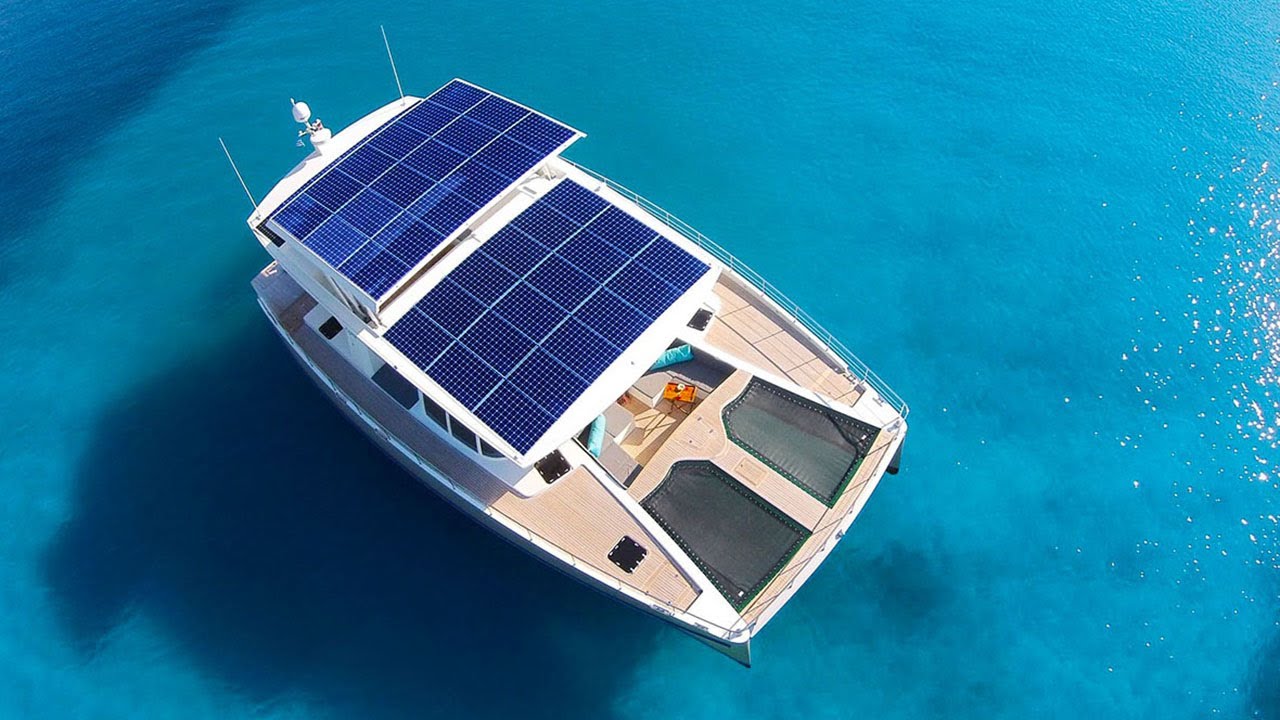
- The Silent 55 carries 30 SunPower solar panels producing roughly 10 kWp, charging a 140 kWh lithium-ion battery bank built with Panasonic cells.
- At a cruising speed of 5 to 6 knots, the yacht runs on virtually unlimited daytime solar range, with daily house loads kept to just 5-10 kWh.
- Twin electric motors come in standard 30 kW form or an optional high-performance 135 kW-per-side setup, backed by a 100 kW Volvo Penta diesel generator reserved for emergencies and high-speed runs.
From the Solarwave 46 to a Clean-Sheet Catamaran
Michael and Heike Köhler didn’t stumble into solar propulsion — they’ve been building toward the Silent 55 for over a decade. Their Solarwave 46 prototype in 2009 first proved that a cruising yacht could run entirely on sun-generated power, and the production Silent 64 followed in 2016 as the concept’s first commercial-scale expression. The Silent 55 is the next iteration, engineered from scratch specifically to strip out the noise, fumes, vibration, and heavy maintenance schedules that come standard with fossil-fueled yachts.
That clean-sheet approach shows up in the build itself. The hull uses carbon-aramid reinforcements to hold total displacement to around 17 tonnes — light enough that the solar array and battery bank can actually move the boat rather than just topping off a diesel-dependent system. It’s the same kind of lightweighting logic that’s driven range gains across electric vehicles more broadly, applied here to a hull instead of a chassis.
The Power Chain: Panels, Panasonic Cells, and Twin Motors
The numbers behind the Silent 55’s drivetrain explain how it achieves genuine energy independence rather than just a green paint job. The 30-panel SunPower array feeding roughly 10 kWp into a 140 kWh Panasonic-cell battery bank gives the yacht enough buffered capacity to run through the night and into cloudy stretches without touching the backup generator. Owners choose between the standard 30 kW electric motors for efficient cruising or the optional performance configuration pushing 135 kW per side for owners who want speed on demand.
The diesel backup — a variable-speed 100 kW Volvo Penta unit — sits insulated in the starboard transom, present but essentially dormant unless the boat needs a high-speed passage or an emergency reserve. That’s a deliberate hedge rather than a crutch: the boat is designed to run on sun first, diesel only when the mission demands it.
At 5 to 6 knots, the Silent 55 runs on solar generation alone — daily house loads of just 5 to 10 kWh against a 10 kWp panel array built to outproduce them.
Built to Need Less Power in the First Place
Half the trick to running a yacht on solar power is cutting how much power it needs to begin with. The Silent 55 leans on heavy thermal insulation and deep window overhangs specifically to blunt the air-conditioning draw that typically eats into a boat’s energy budget in warm-water cruising grounds. Combined with the carbon-aramid hull’s reduced displacement, the design treats efficiency as a structural decision, not an add-on — the same philosophy that’s shown up in other efficiency-first energy projects covered in The FUTURE of Energy Efficient Technology!
Configuration options run from three to six luxury cabins, letting owners scale the interior layout without touching the underlying power architecture. It’s a production yacht in the true sense — not a one-off prototype, but a model buyers can spec and order, which puts it in the same category-creating conversation as other self-sufficient marine builds like the hydrogen-fuel-generating boat that makes its own fuel from seawater.
Understanding Unlimited Solar Range Capabilities
“Unlimited range” sounds like marketing language until you look at the load math. A 10 kWp array against a 5-10 kWh daily house draw means the Silent 55 is producing more power than it consumes on most sunny days, banking the surplus in that 140 kWh reserve for overnight running or overcast stretches. That’s the entire premise Silent Yachts is betting on — that solar and battery technology have finally caught up enough to make a full-size ocean-going catamaran genuinely self-sufficient, not just efficient.
The Silent 55 is listed for sale now, with delivery slots built around whichever cabin configuration and motor package a buyer chooses — 30 kW standard or the 135 kW-per-side performance option. For a company that spent a decade proving the concept with the Solarwave 46 and the Silent 64, the 55 is the version built to actually scale, and the order books are the real test of whether solar-electric catamarans move from novelty to category.






UNBOXING A QUANTUM COMPUTER! – Holy $H!T Ep 19
Intel’s behavior is PATHETIC – Core i9 10980XE Review
MIT’s Breakthrough Energy Technologies
The high-tech future of fashion
10 Most Unusual Vehicles