

 InfoSearched
A truck tug-of-war video went viral, and an engineer took it apart bolt by bolt.
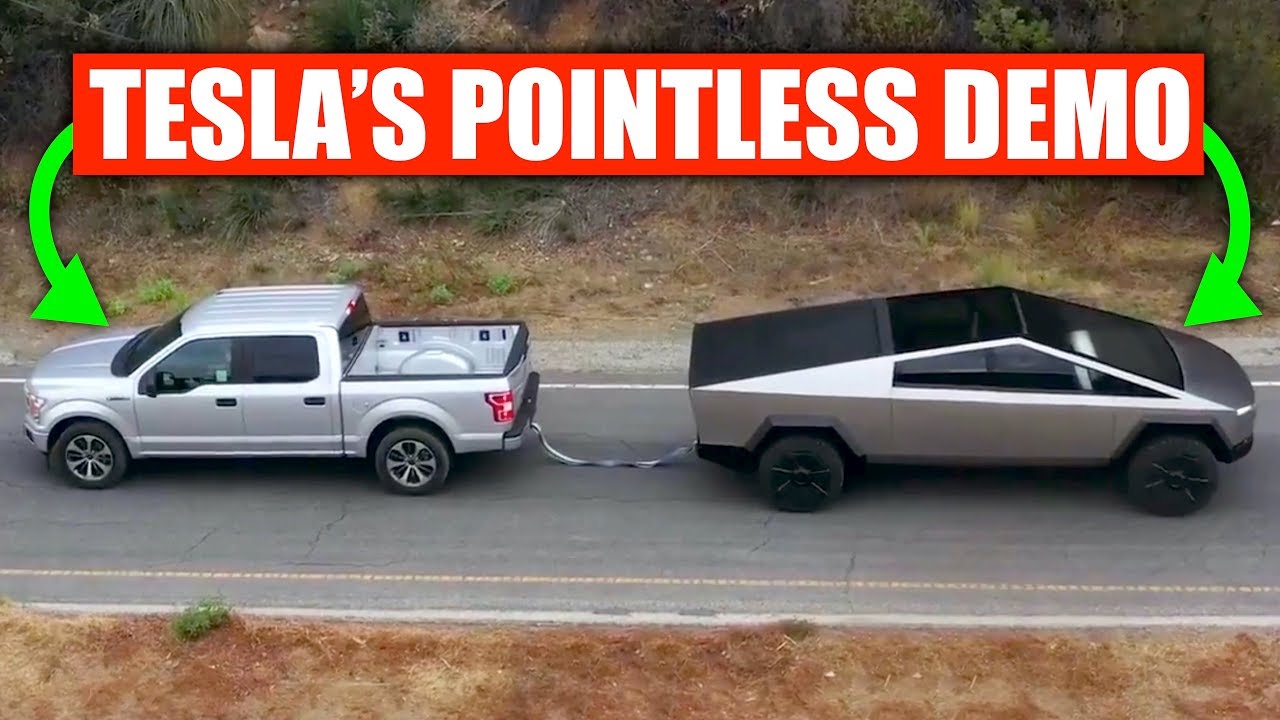
Elon Musk needed a headline moment for the Cybertruck’s chaotic November 21 unveiling, and dragging a Ford F-150 backward uphill delivered one. The clip spread everywhere within hours, framed as proof that Tesla’s stainless-steel truck had just humiliated America’s best-selling pickup. Five days later, Jason Fenske of Engineering Explained published a teardown explaining why the stunt measured almost nothing about either vehicle’s real capability.
- Fenske’s November 26 video, titled “Tesla’s Cybertruck Tug-of-War Stunt Was Pointless,” argues the contest was decided by traction, not horsepower or electric torque.
- The Ford F-150 in Tesla’s demo appeared to be a rear-wheel-drive base model with an empty bed, while the Cybertruck ran all-wheel drive with far more curb weight from its battery pack and steel body.
- The tug happened uphill, a detail that shifted even more weight onto the Cybertruck’s tires while lifting load off the F-150’s rear axle, worsening its grip deficit the moment the pull started.
The Physics of a Traction Contest
Fenske’s core argument is basic vehicle dynamics: pulling force in a tug-of-war is capped by tire grip multiplied by the normal force pressing down on the driven wheels, not by how much torque an engine or electric motor can theoretically produce. Once a tire starts spinning and loses traction, its pulling capacity drops to kinetic friction and stays there, no matter how much power is sitting behind it. That’s the same principle discussed in traction-limited scenarios covered elsewhere in physics breakdowns of real-world vehicle stunts — the number that matters isn’t on the spec sheet, it’s what the tire can actually grip.
Applied to Tesla’s demo, that means the Cybertruck’s torque figures were irrelevant the instant the F-150’s tires broke loose. The Ford’s engine output never got tested, because it never got the chance to matter.
Analysis of Stunt Failure
Two mismatches did the real work in that video, according to Fenske’s analysis. First, the F-150 shown pulling against the Cybertruck looked like a rear-wheel-drive base trim with nothing in the bed, so only a slice of its curb weight sat over the wheels actually trying to grip the pavement. The Cybertruck, by contrast, ran all-wheel drive and carried significantly more curb weight thanks to its large lithium-ion pack and stainless-steel structure — more weight on more driven wheels, straightforward traction math.
Second, the pull went uphill. That incline transferred weight backward and down onto the Cybertruck while lightening the load over the F-150’s rear axle, making an already lopsided matchup worse before either truck’s motor mattered at all. Tesla’s own Cybertruck reveal coverage leaned heavily on moments like this one for shock value, but shock value and engineering proof aren’t the same thing.
Marketing Spectacle vs. Engineering Reality
Fenske wasn’t alone in reaching this conclusion — automotive journalists and engineers who examined the clip largely agreed with his read. The F-150 lost traction almost instantly and spun its tires, meaning its engine output never became the limiting factor in the contest at all.
From a physics standpoint, the demo proved exactly one thing: a heavier all-wheel-drive vehicle beats a lighter rear-wheel-drive truck in a traction contest.
That’s a far narrower claim than “Cybertruck beats F-150,” but it’s the only claim the video actually supports.
Tesla never published the axle weights, tire specs, or trim details for either truck in that clip, so Fenske’s breakdown stands as the closest thing to an actual accounting of what happened in that parking lot. Until Tesla runs the tug-of-war with a matched, loaded, all-wheel-drive F-150, the footage stays exactly what it was built to be: a great marketing shot and a lousy engineering test.


Driving my car around is… weird || TRUCKLA UPDATE + CYBERTRUCK
Working Mandalorian Helmet with HUD! – See 500 Feet In Total Darkness!
The FUTURE of Energy Efficient Technology!
AI is coming for your jobs…so what?
Making a DRIVETRAIN and Installing the Micro V4 ENGINE on the RC Car!