

 InfoSearched
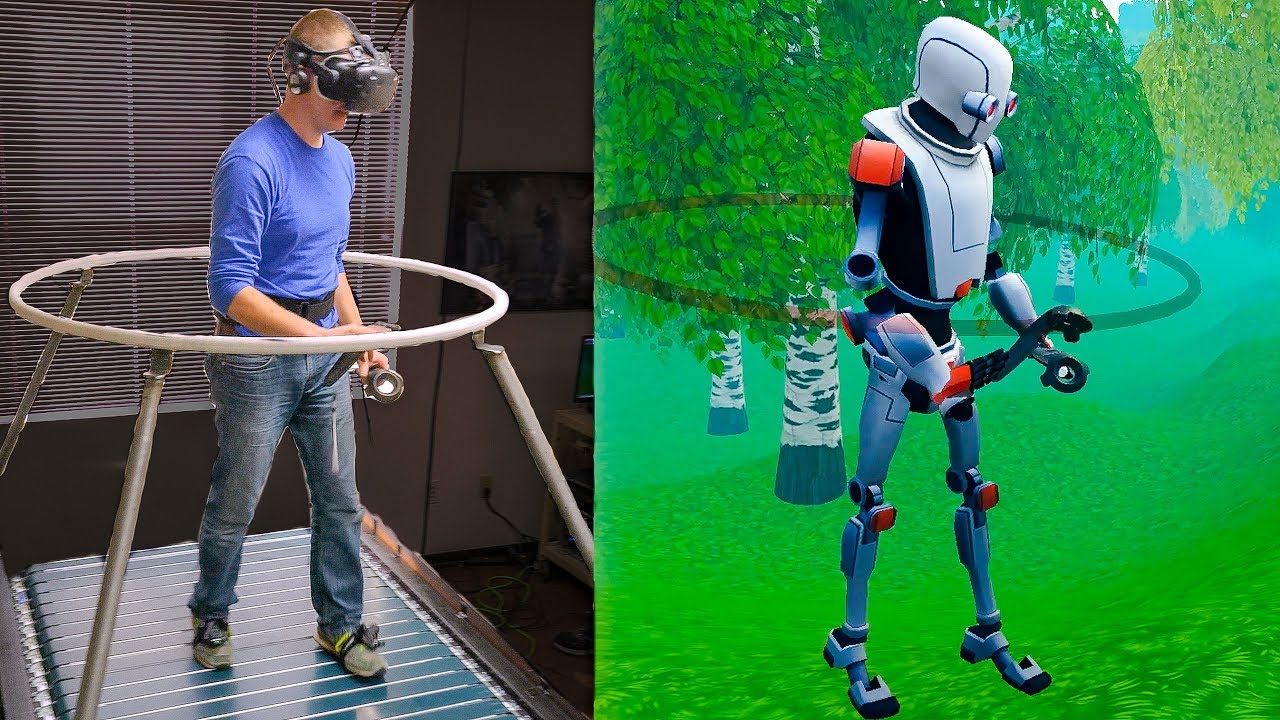
Destin Sandlin climbs onto a treadmill built to make sure he never actually walks anywhere.
In episode 192 of Smarter Every Day, published April 16, 2018, host Destin Sandlin pulls apart the Infinadeck, an omnidirectional treadmill built specifically to solve the locomotion problem in virtual reality. Rather than relying on gimmicks like slippery floors or low-friction bowls that let a user’s feet slide out from under them, the Infinadeck is an active, motorized platform that physically moves the walking surface to cancel out a person’s steps in real time. Sandlin gets under the hood — literally — to show the motors, belts, and control logic that make it work.
- The Infinadeck was invented by George Burger to solve VR locomotion without passive low-friction bowls or slippery footwear.
- It runs on two perpendicular axes of motion: a main belt system that works like a tank tread, layered with dozens of individual transverse belts moving 90 degrees across the surface.
- The unit Sandlin tests is a single-user experimental platform requiring an external safety ring or harness, with sensors tracking displacement and motors continuously pushing the walker back toward center.
Walking Movements Disrupt Virtual Reality
Every VR headset has the same problem once you take more than a step or two: the room runs out. Developers have tried everything from teleportation controls to physical low-friction surfaces that let users’ feet slip in place, but Sandlin frames those as compromises rather than solutions — they either break immersion or feel unnatural underfoot. The Infinadeck’s pitch is that a user should be able to walk, jog, or turn exactly as they would outdoors, with the floor doing the correcting instead of the shoes or the game engine.
Two Axes, Dozens of Belts
The mechanical answer Burger built is a platform that moves on two perpendicular axes at once. One system functions like a tank tread, sliding the whole surface forward and backward. Layered on top of it are dozens of individual transverse belts, each running 90 degrees across the main belt’s direction. Combine the two and the deck can shift a person in any direction on the fly, not just along a single track.
Two axes, dozens of belts, one job: keep the walker pinned to the exact center of the deck.
The Motors, Shafts, and Control Loops Underneath
Sandlin’s episode spends real time on what’s actually driving the surface — motor arrays, drive shafts, and control loops that have to respond to a walking human faster than that human can wander off the platform. It isn’t a passive spinning belt like a gym treadmill; sensors are constantly measuring how far the walker has drifted from center, and the motors fire corrections to push them back before they reach the edge. That’s the core engineering challenge Sandlin keeps circling back to: countering unpredictable human movement in 360 degrees, in real time, without the person on top ever feeling the correction happen.
One Person, One Harness — For Now
Despite marketing claims elsewhere about multi-person commercial VR floors, the unit Sandlin walks on is explicitly a single-user experimental system. It requires an external safety ring or harness to stabilize the walker while the sensory algorithms do their job tracking displacement and commanding the motors. That’s the honest state of the hardware in this episode — a working proof of concept for solving VR locomotion mechanically, not yet a finished consumer product ready to ship without a spotter standing by.
Sandlin’s channel has made a habit of strapping into things most people would call unnecessary risks in the name of a clear explanation — the kind of hands-on demonstration he’s used before when risking his own safety to settle a physics debate. The Infinadeck episode fits that same mold: less about hyping VR’s future and more about showing, belt by belt and motor by motor, exactly how a machine convinces your legs you’re walking somewhere you’re not — a problem that sits right at the intersection of hardware engineering and the kind of immersive gaming experience video games have been chasing for years.




How Close Are We to Fusion Energy?
9 AMAZING NEW GADGETS YOU CAN BUY ON AMAZON AND ONLINE
First Manned Aerobatic RACING Drone – Will it FLIP? ????
World’s First Protosaber! (REAL BURNING LIGHTSABER)
New Medical Technology In 2019