

 InfoSearched
A converted racing catamaran just proved a boat can make its own fuel from the ocean it’s floating on.
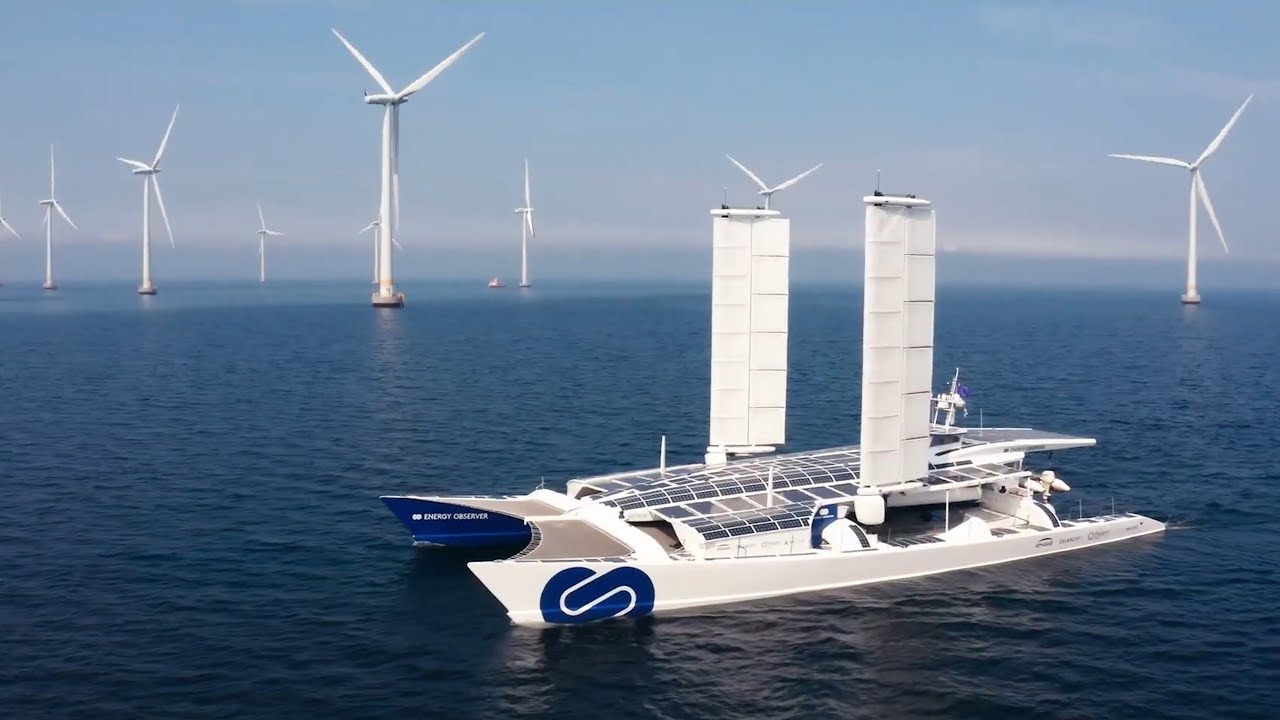
The Energy Observer isn’t a concept sketch or a lab prototype — it’s a working vessel that has spent years crossing oceans while brewing its own hydrogen out of seawater. Built from a decommissioned racing catamaran and outfitted as a floating laboratory, the ship pairs solar, wind, and hydro power with an onboard electrolyzer that turns purified seawater into carbon-free fuel. It’s the kind of engineering flex that sounds like science fiction until you check the specs.
- Founder and captain Victorien Erussard and expedition leader Jérôme Delafosse set off from Saint-Malo, France, in 2017 on a multi-year voyage covering 50 countries and 101 ports of call.
- The boat stores hydrogen at 350 bar across eight tanks built into its wings, holding up to 62 kg — enough for roughly six days of autonomy.
- In 2019, the vessel swapped its original wind turbines for Oceanwings automated rigid sails, part of a hybrid system that also includes more than 130 square meters of solar panels.
Vessel Self-Sustaining Power Systems
The whole system runs on a simple premise: don’t waste sunlight or wind you can’t use right away. When the solar array, the Oceanwings sails, and the reversible electric motors doing hydrogeneration generate more power than the Energy Observer needs in the moment, that surplus gets redirected instead of dumped. Lithium-ion batteries handle the short-term buffering, but the real trick happens when there’s power left over even after the batteries are topped off.
That excess energy drives seawater through onboard desalination units, stripping out salt and impurities before the purified water hits an electrolyzer. There, an electric current splits the water molecules into oxygen and hydrogen gas — the same basic chemistry taught in high school labs, just scaled up and hardened for the open ocean. The setup is a floating cousin to the power-to-gas storage concept that’s been explored on land for years.
Storing and Burning the Hydrogen
Once the electrolyzer produces hydrogen, the gas gets compressed to 350 bar and packed into eight specialized tanks integrated directly into the boat’s wing structures. Fully loaded, those tanks hold up to 62 kg of hydrogen — a reserve engineers calculate as roughly six days of vessel autonomy if the sun and wind disappear entirely.
When renewable generation drops off, that stored hydrogen feeds a fuel cell built with Toyota fuel-cell technology, converting the gas back into electricity. The only byproducts venting out are heat and clean water — no greenhouse gas emissions at any point in the loop.
Eight wing-mounted tanks, 62 kg of hydrogen, six days of autonomy — and the only exhaust is water.
A Six-Year Testbed for Harsh Conditions
What separates the Energy Observer from a dockside demo is exposure. Erussard and Delafosse didn’t build this to sit in a marina — they sent it around the world specifically so saltwater, storms, and years of continuous operation could stress-test the electrolysis and storage hardware in conditions a lab bench can’t replicate. Visiting 101 ports across 50 countries since leaving Saint-Malo in 2017 has turned the boat into a rolling proof-of-concept for maritime decarbonization, the same kind of durability argument you see with vessels like the Silent Yachts 55 solar yacht, just pushed much further offshore and for much longer stretches.
The catamaran’s hybrid architecture — solar, wind, hydro, batteries, and hydrogen all working together rather than any single source carrying the load — is the part naval engineers are watching closest. If electrolysis and fuel-cell hardware can survive years of open-ocean punishment on the Energy Observer’s wings, that’s the data point commercial shipping and coastal ferries need before anyone bets real cargo routes on it.






The FUTURE of Energy Efficient Technology!
Sam Harris on Artificial Intelligence
The Five Laws of Cybersecurity | Nick Espinosa | TEDxFondduLac
The Extreme Physics Pushing Moore’s Law to the Next Level
Relationships Mapped: Data-driven Leadership with Network Analysis