

 InfoSearched
A YouTuber let his Tesla drive itself across four states, and the charging stops nearly broke him.
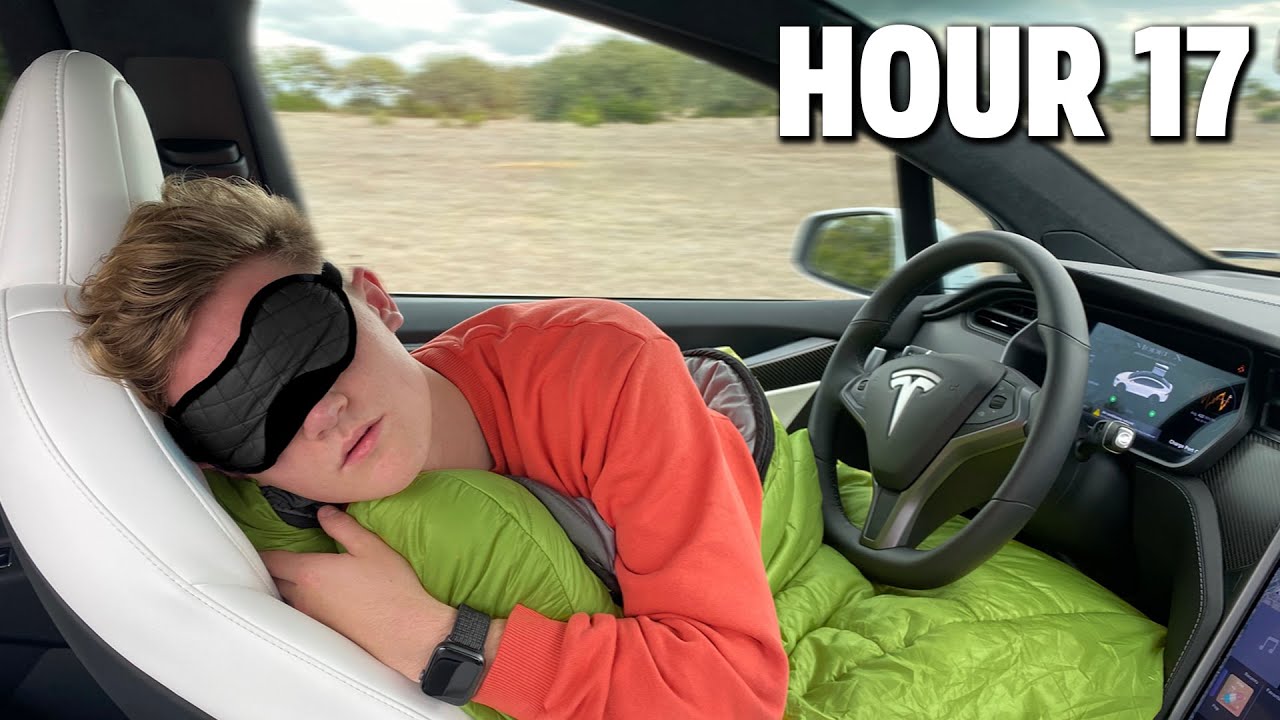
Ryan Trahan built his channel on stunts that sound simple until you actually try them, and “Tesla Autopilot For 24 Hours Straight!” is exactly that kind of premise. In late January 2020, the YouTuber and a group of friends pointed a Tesla Model X north out of Austin, Texas, aiming for Chicago, Illinois — a 1,200-plus mile run he planned to complete leaning as heavily as possible on Tesla’s Autopilot driver-assistance system. What was supposed to be a 17-hour drive in a normal gas car turned into something closer to a day-and-a-half ordeal once charging entered the equation.
- The Austin-to-Chicago route covers roughly 1,200-plus miles and takes about 17 continuous hours in a standard combustion vehicle.
- Trahan’s Tesla Model X run stretched to somewhere between 27 and nearly 40 total hours, with the group spending close to 10 hours parked at Superchargers alone.
- Because Trahan had grandfathered free Supercharging, the entire trip cost him nothing beyond food — no charging fees at all.
The Route and the Math That Didn’t Add Up
The appeal of the trip was obvious on paper: let the car do the driving, sit back, and knock out a cross-country haul without touching the wheel. The reality was a lot more logistical. Every few hours the group had to divert off the most direct highway path to reach a Supercharger, then sit and wait while the Model X topped up — turning a straightforward interstate run into a stop-and-go grind. Add in reduced range from cold winter temperatures along the northern legs of the route, and the “24 hours straight” premise in the title ballooned well past a full day, landing somewhere between 27 and almost 40 hours by the time they rolled into Chicago.
Actual Capabilities of Autopilot Systems
Once the car was moving, Trahan said Autopilot delivered on the thing people actually want from it: it took the edge off the physical grind of a long highway drive. He described feeling more like a passenger watching the scenery than a driver white-knuckling a wheel for hundreds of miles, which lines up with how Tesla owners commonly use the Level 2 system on interstate stretches. But Trahan was clear that “hands-off” doesn’t mean “brain-off” — he repeatedly told viewers the system isn’t foolproof and that drivers still need to stay alert and ready to intervene, echoing warnings that have followed Autopilot since it launched, including incidents where the system has struggled with lane markings and static obstacles on the highway.
Nearly 10 hours of the trip were spent just sitting at Superchargers — more time charging than most people spend on the entire drive.
The Verdict on Long-Distance EV Travel
Trahan’s bottom line was blunt: interesting experiment, safe, genuinely free thanks to his grandfathered Supercharging perk — but not something he’d recommend or do again. The combination of charging delays, cold-weather range loss, and the sheer exhaustion of being on the road for well over a full day outweighed the novelty of letting the Model X handle most of the steering. It’s the same tension that shows up whenever EV road-tripping gets tested against a straight highway run: the driving itself gets easier, but the trip gets longer.
Trahan wrapped the video with no plans for a rematch, and it’s easy to see why — nobody signs up twice for a drive where the charging stops eat almost half a day. If anything, the video reads as a real-world gut check on Autopilot road trips at a moment when Tesla was pushing the system harder than ever, right as the company’s Cybertruck reveal and other stunts were dominating the same news cycle.


Top 10 Energy Sources of the Future
Driving my car around is… weird || TRUCKLA UPDATE + CYBERTRUCK
The danger of AI is weirder than you think
Risking My Life To Settle A Physics Debate
THE FUTURE U.S. ARMY – FUTURISTIC WEAPONS FROM D.A.R.P.A. (National Geographic Documentary