

 InfoSearched
A YouTuber just built a real lightsaber that sets things on fire — and it actually works.
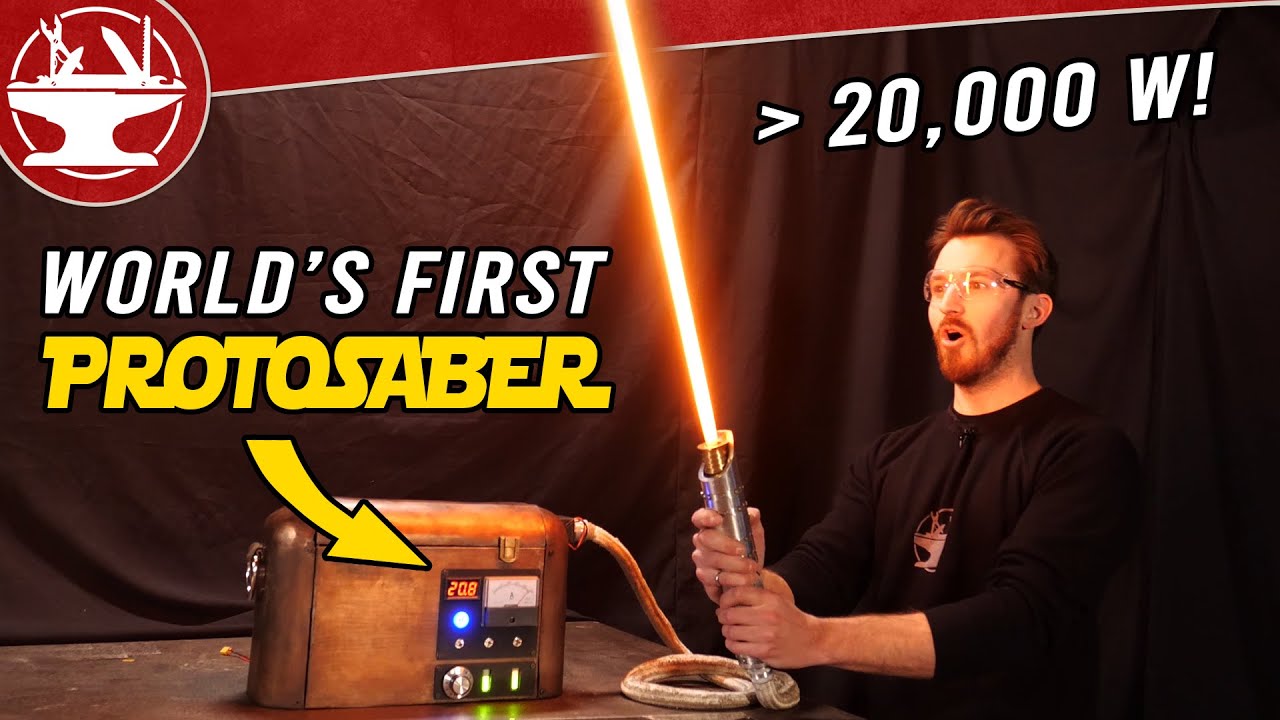
James Hobson, the Canadian engineer behind the YouTube channel Hacksmith Industries, spent December 2019 chasing something Star Wars fans have wanted since the prequels: a lightsaber that isn’t just glowing plastic. His answer, unveiled in the video “World’s First Protosaber! (REAL BURNING LIGHTSABER),” skips the impossible physics of a self-contained energy blade entirely and instead builds the thing lore-accurate old-school Jedi actually used — a saber tethered to an external power source.
- The build runs on a wearable, steampunk-styled backpack housing a custom battery pack that discharges 20 kilowatts of power — roughly 20 volts at 1,000 amps, enough juice to run half an average North American home.
- That current is routed through heavy cabling into an isolated hilt holding a solid tungsten blade, which acts as an intentional, massive short circuit that superheats the metal white-hot.
- Early tungsten blades caught fire and burned out under the load during testing, forcing Hobson’s team to switch to a thicker piece of tungsten that could actually survive the 20kW draw.
The Mechanics of Protosaber Technology
There’s no plasma stream and no containment field here — the protosaber is pure brute-force electrical engineering. Hobson’s backpack feeds an enormous current through cabling into the hilt, where a solid tungsten core takes the full 1,000-amp load. Tungsten has one of the highest melting points of any metal on Earth, which is exactly why it was chosen: it’s one of the only materials that can absorb that kind of resistive heating without instantly vaporizing.
The result is a blade that glows white-hot from base to tip, capable of burning and melting through everyday objects on contact. It’s the same principle behind a toaster element or an arc welder, just scaled up and shaped into a hilt-and-blade format that looks like it walked off the set of a prequel-era lightsaber duel.
Getting the Build to Survive Its Own Power
The hardest part wasn’t generating 20 kilowatts — it was finding a blade that could take it. During initial testing, the tungsten pieces couldn’t handle the full electrical load and burst into flames before the team could even get a clean demonstration. Hobson’s crew had to go back and source a thicker tungsten blank capable of surviving sustained current at that amperage without simply cooking itself apart.
20 volts at roughly 1,000 amps — enough to power half a house — routed straight through a bar of tungsten until it glows white-hot.
That kind of high-amperage resistance heating is the same category of engineering problem Hacksmith has tackled in other builds, including the channel’s working Mandalorian helmet with a functioning HUD, where getting real-world hardware to match a prop from the screen meant solving power, heat, and durability problems all at once.
No Containment Field, No Safety Net
Once the upgraded blade was in place, Hobson wielded the finished protosaber with nothing more than a pair of safety glasses. There’s no magnetic containment, no cooling jacket, no emergency cutoff mentioned in the build — just a superheated metal blade fed by a backpack rated to output as much power as half a house pulls at once. It’s a blunt, almost old-fashioned way to solve the lightsaber problem: instead of engineering around the danger, the build leans into it.
The tethered-backpack format is also a direct nod to Star Wars canon rather than a shortcut. Early lightsabers in the mythology needed an external power cell precisely because self-contained energy blades weren’t feasible — Hobson’s design mirrors that constraint instead of hiding it, which is part of why the build reads as a “protosaber” rather than a finished lightsaber prop.
Placement in Hacksmith Build History
Hacksmith has spent years chasing real-world versions of sci-fi hardware, from wearable armor to functional replica gear, and the protosaber slots into that same lineage of turning fictional tech into something you can actually hold — and in this case, actually get burned by. The channel’s willingness to run 1,000 amps through a hilt for the sake of screen accuracy says a lot about how far the “real-life prop replica” genre on YouTube has pushed since the days of painted foam swords.
Hobson’s team would go on to rework the concept later in 2020 into a retractable gas-fed plasma torch design, but this particular December 2019 build stayed strictly analog: a tungsten core, a backpack full of amps, and a straightforward short circuit doing all the work.





10 SECRET Military Technologies
MIT’s Breakthrough Energy Technologies
Relationships Mapped: Data-driven Leadership with Network Analysis
Sustainable energy: New energy innovations to make the future brighter – Compilation
Tesla Autopilot For 24 Hours Straight!