

 InfoSearched
A booster that’s flown six times now sticks another landing in the West Texas desert.
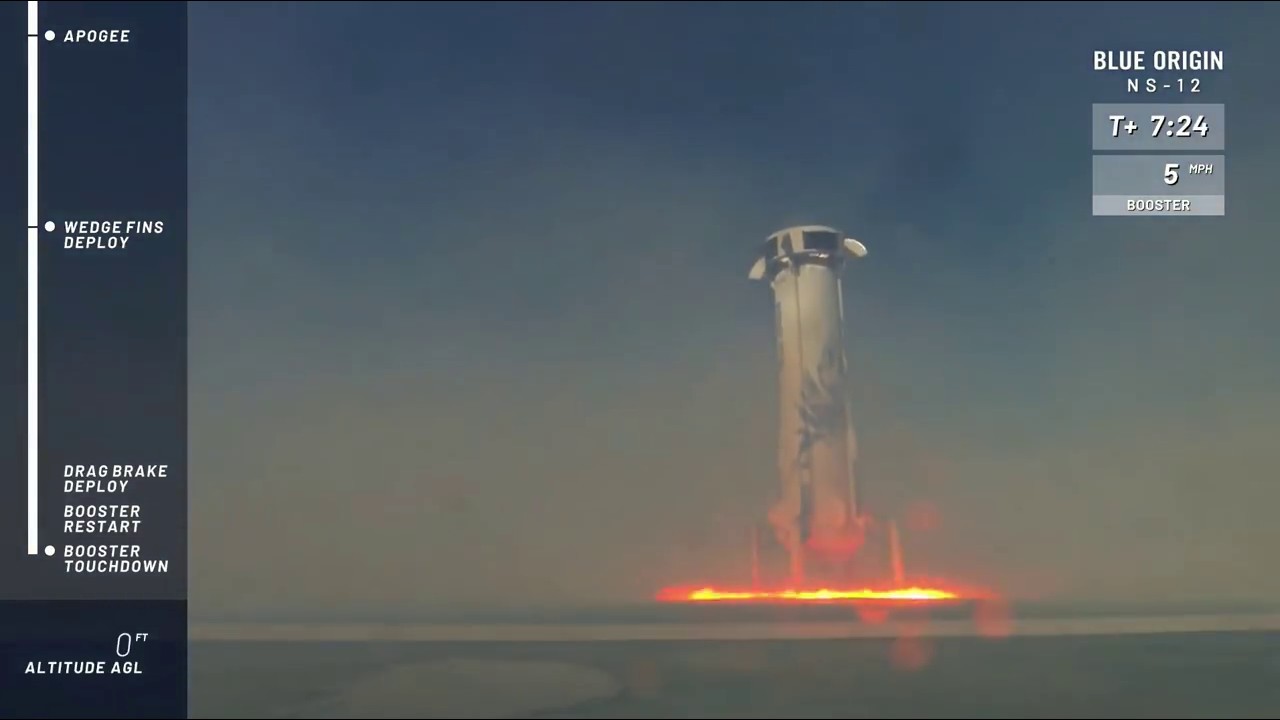
Blue Origin closed out 2019 with a rocket that refuses to quit. On December 11, the company’s New Shepard vehicle lifted off from its Corn Ranch site near Van Horn, Texas, sent an uncrewed capsule past the edge of space, and brought its booster back down onto the same launch pad for the sixth time. The mission, designated NS-12, was delayed a day by bad weather and pushed back again by morning fog, but once it flew, it delivered exactly the kind of routine-looking, hard-to-engineer result Jeff Bezos’s company has been chasing for years.
- Lift-off happened at 12:53 p.m. EST (11:53 a.m. local, 17:53 UTC) after a one-day weather delay and fog on launch morning.
- The capsule reached an apogee of 343,061 feet — about 65 miles, or 104.5 km — crossing the Kármán line before parachuting back down.
- Booster NS-3 landed itself for the sixth consecutive time, breaking Blue Origin’s previous reusability record of five flights on one booster.
The Flight Profile
New Shepard’s BE-3 engine, burning liquid hydrogen and liquid oxygen, pushed the vehicle to a peak velocity of 2,227 mph before booster separation at two minutes and 45 seconds into the flight. From there the booster deployed its ring fins to steady its fall, relit the BE-3 for a braking burn, and touched down vertically on the pad just seven minutes and 25 seconds after leaving it. The Crew Capsule 2.0 — named RSS H.G. Wells — kept climbing on its own momentum before tipping over at apogee and drifting back to the Texas scrub under parachutes.
NS-12 was the 12th flight overall in the New Shepard test program and the ninth to carry a commercial payload, a track record that’s starting to look less like a test campaign and more like an operating schedule.
Six Flights, One Booster
The headline number is the reusability streak. NS-3, the specific booster used on this flight, had now flown to space and landed intact six times in a row, topping the company’s own prior mark of five. That kind of repeat performance is the entire point of New Shepard’s design — a rocket that lands itself upright on a pad instead of being thrown away after a single use, the same logic that underpins reusable-rocket programs across the industry covered in the next generation of space technology.
Six consecutive flights to space and back for the same booster — a new company record, and the twelfth New Shepard mission overall.
Cargo Manifest Revealed
NS-12 carried Blue Origin’s 100th commercial payload, a NASA experiment testing waste-gasification technology meant to turn spacecraft trash into propulsion and life-support gases for deep-space missions — the kind of practical hardware that keeps showing up in coverage of how tech built for orbit ends up solving problems back on Earth. Also flying was a Columbia University study on cell biology in microgravity, plus thousands of postcards submitted by students through Club for the Future, Blue Origin’s nonprofit STEM education arm.
None of it was glamorous cargo, but it’s exactly the mix Blue Origin has been building toward: paying customers, university researchers, and NASA all riding the same capsule on the same afternoon, treating a trip past the Kármán line as a scheduling problem rather than a moonshot.
Future Status of the Program
Blue Origin has still never flown a person on New Shepard, and NS-12 didn’t change that — it was uncrewed, like every flight before it. But a sixth clean landing on the same booster is the kind of data point that matters most before the company puts someone in that capsule for real, and it keeps New Shepard’s flight cadence moving in the direction Bezos has been promising since the program’s earliest hops.





How Close Are We to Fusion Energy?
9 AMAZING NEW GADGETS YOU CAN BUY ON AMAZON AND ONLINE
MIT’s Breakthrough Energy Technologies
THE FIRST EVER HOVERBIKE IN THE WORLD
How Tech Designed for Space Is Saving Lives on Earth