

 InfoSearched
A Vancouver engineer built a four-legged, human-piloted racing machine and Guinness World Records just made it official.
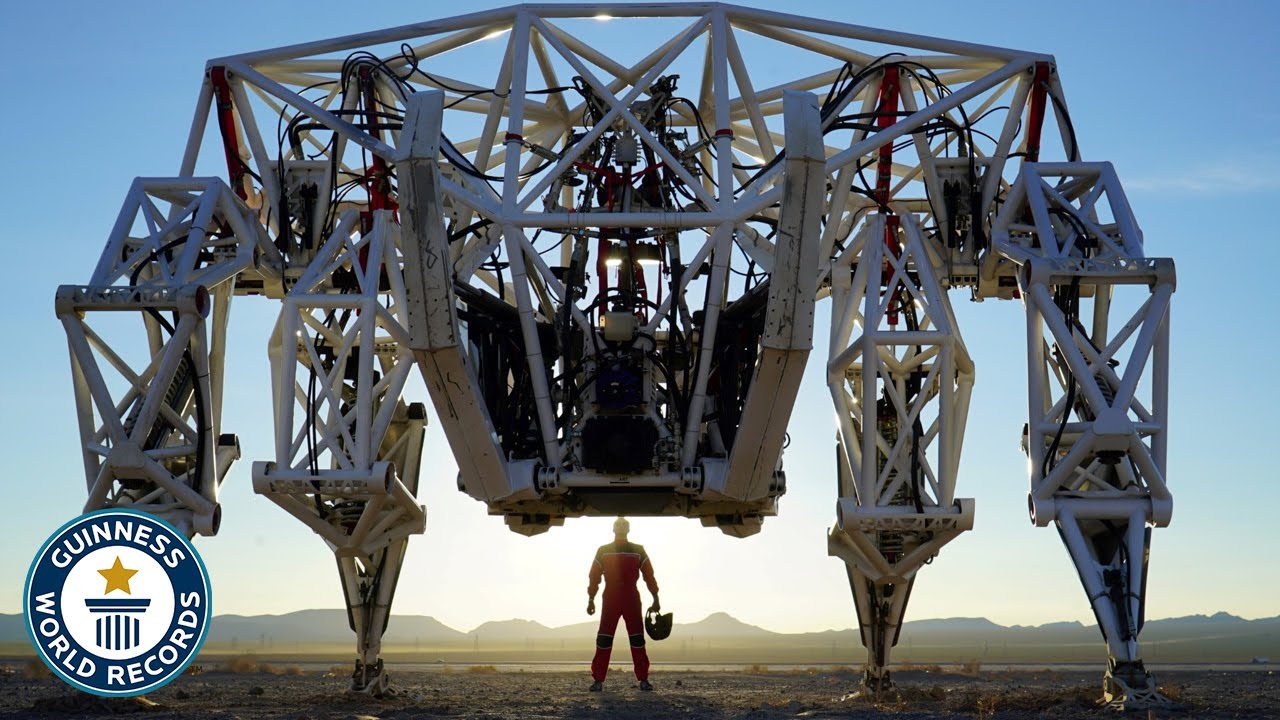
Jonathan Tippett spent 13 years chasing an idea most people would have written off as science fiction: a giant mechanical exo-skeleton that a human pilot could physically wear and race. In January 2020, Guinness World Records confirmed his creation, PROSTHESIS, as the world’s largest tetrapod exo-skeleton. Built in British Columbia, the machine isn’t a concept render or a museum piece — it runs, it walks on four legs, and it was designed from the start to be raced.
- PROSTHESIS stands 3.96 meters (12 ft 11 in) tall, stretches 5.1 meters (16 ft 8 in) long and 5.51 meters (18 ft 1 in) wide.
- Its frame and four legs are built from 1,600 kg (3,527 lb) of Chromoly steel tubing, the same chromium-molybdenum alloy used in aerospace and motorsport chassis.
- A 96-volt, 36-kWh lithium-ion battery pack drives two AC electric motors that power hydraulic cylinders delivering up to 12,000 pounds of force each — with zero autonomous controls, run entirely by a human pilot inside the cockpit.
The Engineering Behind the Machine
PROSTHESIS has no onboard computer telling its legs where to step and no automated balance system catching it if it stumbles. Every motion comes from the pilot suspended inside the cockpit, whose arm and leg movements are read by a sensitive exo-frame interface and translated directly into hydraulic commands. That signal routes through two AC electric motors, which drive hydraulic pumps pushing fluid into cylinders capable of producing up to 12,000 pounds of force apiece — enough to swing a leg built from aerospace-grade steel tubing through a stride.
The choice of Chromoly steel wasn’t incidental. It’s the same alloy family engineers reach for in aircraft frames and race car chassis because it holds strength at a fraction of the weight of ordinary steel, a critical factor when 1,600 kg of tubing has to move like a limb rather than sit like a girder. The result is closer in spirit to something out of the walking-mech builds featured in the current wave of prosthetics and human-machine interface research than to any conventional off-road vehicle.
Thirteen Years From Idea to Guinness Record
Tippett didn’t build PROSTHESIS overnight. The conceptual and mechanical groundwork stretched across 13 years, though the actual physical build came together in under a year once the design was locked. What followed was more than three years of intensive field testing — refining the hydraulics, the control interface, and the pilot ergonomics before the machine was ready to be shown off as a finished proof of concept.
That patience is what separates PROSTHESIS from the countless off-road concept vehicles that never leave a garage. It’s a fully functional prototype that Guinness World Records could measure, weigh, and verify — landing the “largest tetrapod exo-skeleton” title in January 2020.
“I wanted to build a machine that celebrated the age-old pursuit of physical mastery and human skill. I combined it with modern technology to create an entirely new sport.” — Jonathan Tippett
Built for a Sport That Doesn’t Exist Yet
Tippett isn’t framing PROSTHESIS as a one-off novelty. He built it as the proof-of-concept prototype for an entire off-road mech racing league, one where pilot skill and physical endurance matter as much as horsepower. In his own words, the goal is a sport that will “pit pilot against pilot in massive, agile, high-powered, all electric, off-road running machines” — essentially a new athletic discipline built around piloting heavy electric robotics rather than driving a wheeled vehicle.
That ambition puts PROSTHESIS in a different category from the electric off-roaders and 4×4 builds that have been showing up on the aftermarket circuit, like the Beast Electric 4X4 off-road project. Those machines are still cars with drivers behind a wheel. PROSTHESIS has no wheel, no seat in the traditional sense, and no steering column — the pilot’s own limbs are the controls, wired directly into 12,000-pound hydraulic force through the exo-frame.
PROSTHESIS remains a single prototype for now, not a fleet, which means the mech-racing league Tippett describes is still a vision rather than a scheduled event. But with a Guinness World Records title in hand and three-plus years of field testing already logged, the next real test is whether a second machine — and a second pilot — ever lines up next to it on a starting line.




A Multimillionaire Surveillance Dealer And His $9 Million WhatsApp Hacking Van | Forbes
“This Could Be a Tragedy For Humanity” | The First Brain Chip Implant
Tesla Autopilot For 24 Hours Straight!
This researcher created an algorithm that removes the water from underwater images
The FUTURE of Energy Efficient Technology!