

 InfoSearched
Five separate teams are racing to squeeze electricity out of typhoons, raindrops, and even dirty water.
A TomoNews US compilation rounds up five clean-energy projects that quietly moved from lab bench to prototype in the mid-2010s, each attacking the climate problem from a different angle. None of them look like a conventional solar farm or wind turbine — one runs on bacteria, one runs on rain, and one is built to survive a typhoon instead of shutting down before it hits. Together they sketch out what “sustainable energy” looks like when engineers stop copying each other’s homework.
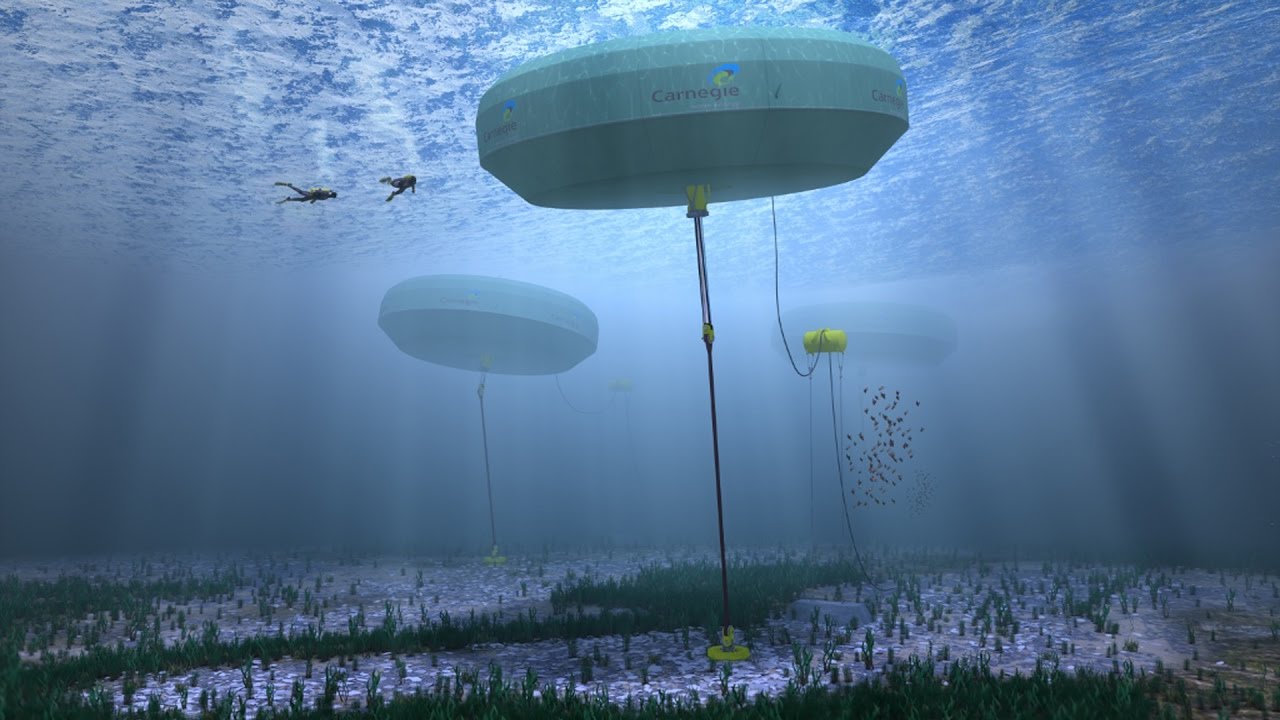
- Perth-based Carnegie Clean Energy tested its CETO system of submerged buoys off Garden Island, Western Australia, generating both hydroelectric power and desalinated water from ocean swell in a single process.
- Researchers at Ocean University of China and Yunnan Normal University coated solar cells in graphene, letting the panels generate a charge from the ammonium, calcium, and sodium ions in falling rain.
- Challenergy founder Atsushi Shimizu built a vertical-axis turbine using the Magnus effect specifically to withstand — and harvest power from — the typhoons that regularly slam into Japan.
Wave Power That Makes Its Own Drinking Water
Carnegie Clean Energy, which started life as Carnegie Wave Energy, built its CETO system around fully submerged buoys anchored offshore at Garden Island. Ocean swell drives the buoys up and down, and that motion pumps high-pressure seawater through a pipeline to shore, where it spins hydroelectric turbines to make electricity. The same pressurized water stream is routed straight into reverse-osmosis desalination units, so one wave-powered system produces zero-emission power and fresh water at the same time — a pairing that matters most in coastal regions where both grid electricity and clean drinking water are scarce.
Solar Panels That Work in the Rain
Solar power’s obvious weakness is bad weather, which is exactly what a team from Ocean University of China and Yunnan Normal University set out to fix. They layered a thin sheet of graphene over conventional solar cells, and the coating behaves like a pseudocapacitor: the ammonium, calcium, and sodium ions dissolved in ordinary rainwater interact with the graphene to generate an electrical charge as droplets hit the surface. The upshot is a panel that keeps producing power through cloudy, rainy stretches instead of going idle — a fix that could matter as much for grid reliability as raw panel efficiency, a topic covered in depth in Top 10 Energy Sources of the Future.
Turbines Built to Survive a Typhoon
Japanese engineer Atsushi Shimizu, founder of the startup Challenergy, took a different problem head-on: Japan gets hammered by typhoons every year, and standard propeller-blade wind turbines have to shut down or risk destruction in that kind of wind. Shimizu’s design ditches blades entirely for omnidirectional vertical cylinders that exploit the Magnus effect — the same aerodynamic principle that curves a spinning baseball — to generate power from wind coming out of any direction at extreme force. Instead of bracing for a typhoon to pass, the turbine is engineered to draw energy out of it.
A wind turbine designed not to survive a typhoon, but to feed off one.
Biobatteries Powered by Bacteria and Bodily Fluids
At Binghamton University, part of the State University of New York, Professor Seokheun Choi’s lab built foldable, paper-based biobatteries that generate micro-power through bacterial respiration. Drop bacteria-rich dirty water or a bodily fluid onto the disposable paper cell, and microbial activity sparks enough current to run point-of-care diagnostic tests — a design aimed squarely at resource-limited clinics where refrigerated batteries and reliable power grids aren’t a given.
The Bionic Leaf’s Solar-to-Fuel Trick
Harvard scientists Daniel Nocera and Pamela Silver pushed artificial photosynthesis further with their “Bionic Leaf 2.0.” An artificial leaf splits water into hydrogen and oxygen using solar energy, and an engineered bacterium, Ralstonia eutropha, consumes that hydrogen alongside carbon dioxide to produce liquid fuels such as isobutanol. Nocera and Silver’s system converts solar energy into fuel at an efficiency that surpasses natural photosynthesis — the kind of number that puts artificial-leaf research in the same conversation as the storage breakthroughs detailed in MIT’s Breakthrough Energy Technologies.
None of these five projects were shipping at commercial scale as of this compilation — Carnegie’s CETO buoys were still offshore prototypes at Garden Island, and Challenergy’s Magnus turbines were being tested against Japan’s typhoon season one storm at a time. But the common thread is worth clocking: each team picked the exact condition that usually kills clean energy — no wind, no sun, salt water, bad weather, a typhoon warning — and built the technology to run on it instead of around it.





Tesla Autopilot For 24 Hours Straight!
Real-life ‘Iron Man’ showcased his jetpack technology to military teams.
The high-tech future of fashion
Tesla Earthquake Machine [3D Printed]
My Regrets as a Computer Science Student