

 InfoSearched
A YouTuber just rebuilt Nikola Tesla’s most infamous invention on a desktop 3D printer.
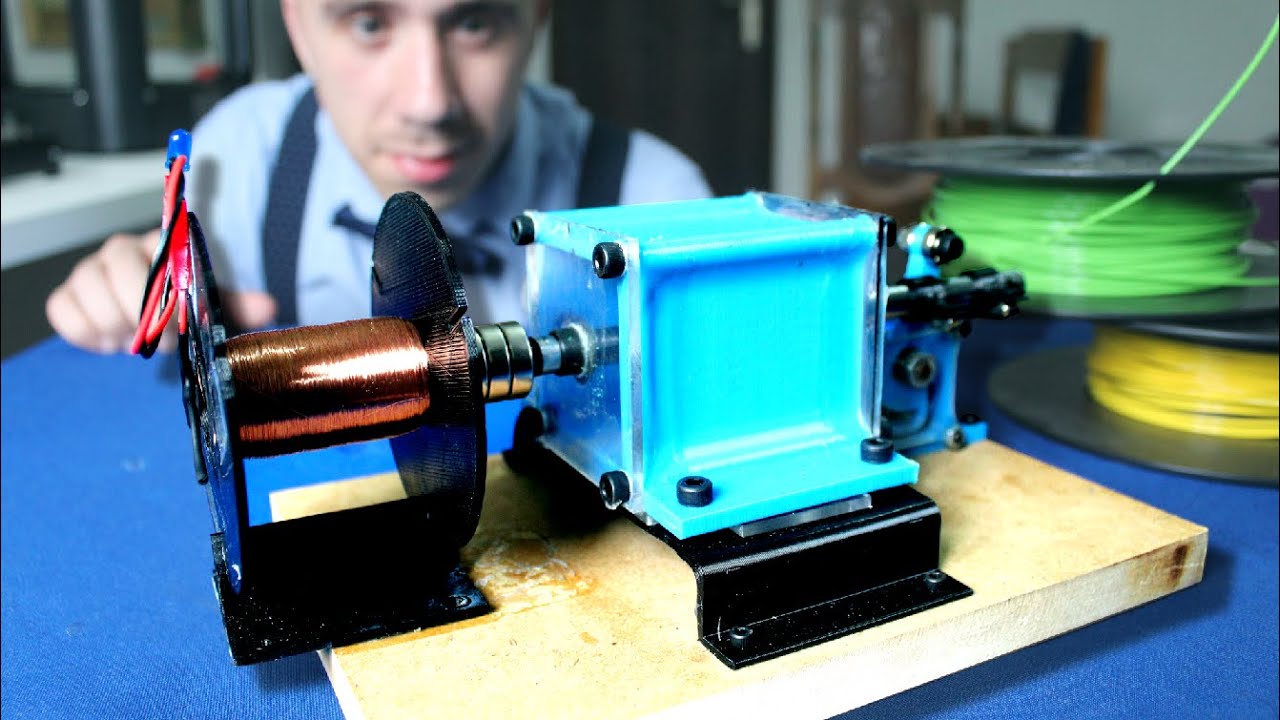
Integza, the engineering channel known for turning garage experiments into working hardware, set out to answer a century-old question: did Tesla’s so-called “earthquake machine” actually work? Rather than speculate, he printed the mechanical core of Tesla’s reciprocating oscillator and ran it under compressed air to see what the patented design could really do. The result is a hands-on teardown of one of Tesla’s strangest and most misunderstood inventions.
- Tesla patented the mechanical oscillator in the 1890s as a steam-powered device meant to generate alternating current at stable frequencies.
- Tesla later claimed a pocket-sized version tuned into the resonant frequency of his Manhattan lab building, shaking the neighborhood until he smashed it with a hammer.
- Integza’s 3D-printed reconstruction uses pneumatic pressure to drive an internal shuttle back and forth in rapid oscillation, with no rotating crankshaft involved.
The Original Patent Behind the Legend
Long before the “earthquake machine” nickname stuck, Tesla’s oscillator was a piece of practical electrical engineering. The patented design used steam pressure to reciprocate a piston, and that reciprocating motion was harnessed to generate alternating current at a stable, tunable frequency. It was Tesla’s answer to the noisy, wear-prone rotating generators of his era — a way to produce AC power without a traditional crankshaft grinding away.
The device’s reputation shifted from useful generator to urban legend after Tesla described testing a small version in his own laboratory. He claimed the little oscillator found the resonant frequency of the building itself, and the vibrations grew until furniture shook and neighbors reportedly called the police. Whether that story is exactly true or embellished over decades of retelling, it’s the reason the machine is remembered today less as an AC generator and more as a doomsday device.
Printing Tesla’s Mechanism in Plastic
Integza’s approach strips the legend down to its mechanical bones. Instead of chasing the myth, he 3D prints the actual shuttle-and-cylinder arrangement described in Tesla’s patent, replacing steam with compressed air as the driving force. The printed piston sits inside a sealed housing, and when air pressure is applied, it snaps back and forth at high speed, mimicking the oscillation Tesla engineered more than a century ago.
That kind of build sits comfortably alongside the maker-first approach seen in Tesla Valve Explained With Fire, where another passive Tesla-era design gets tested with modern tools instead of just described on paper. Integza treats the oscillator the same way — as a mechanism to be measured, not just admired.
Putting the Oscillator Under Pressure
Once the printed prototype is assembled, Integza pressurizes it and watches how the shuttle behaves under load. The video breaks down whether the vibration generated by a compact, desktop-scale version could realistically transmit enough energy through a structure to cause the kind of shaking Tesla described, or whether the AC-generating function of the original patent was always the more credible use case.
The shuttle doesn’t need to spin anything — it just needs to hit resonance.
That distinction matters. Tesla’s oscillator was never really designed as a weapon; it was designed as a generator that happened to produce resonant vibration as a side effect. Integza’s testing reframes the “earthquake machine” story as less about seismic destruction and more about how sensitive mechanical systems are to matching a structure’s natural frequency — a principle that shows up constantly in maker projects like Making a DRIVETRAIN and Installing the Micro V4 ENGINE on the RC Car!, where getting moving parts tuned correctly is the whole battle.
Separating the Engineering from the Legend
What the printed replica actually demonstrates is a small, efficient reciprocating mechanism — not a city-block-shaking superweapon. Integza’s build shows the oscillator can hit rapid, stable cycles under air pressure, which lines up with its original patent purpose as an AC generator rather than the pocket-sized quake generator of Tesla folklore. It’s a reminder that even Tesla’s most sensational stories usually have a mundane, well-engineered mechanism sitting underneath them.
Integza has said he wants to keep pushing this build further, testing whether a scaled-up printed version can hold pressure long enough to actually spin a small AC generator — the job Tesla designed it for in the first place. If that follow-up video lands, it’ll settle the argument the original patent was actually making, a century late.





Working Mandalorian Helmet with HUD! – See 500 Feet In Total Darkness!
Tesla Earthquake Machine [3D Printed]
AI is coming for your jobs…so what?
The Infinadeck Omnidirectional Treadmill
this E–Bike is basically just an Electric Motorcycle you can ride on bike trails