

 InfoSearched
A rocket scientist who once steered a Mars parachute now answers the hardest questions about vacuum-tube travel.
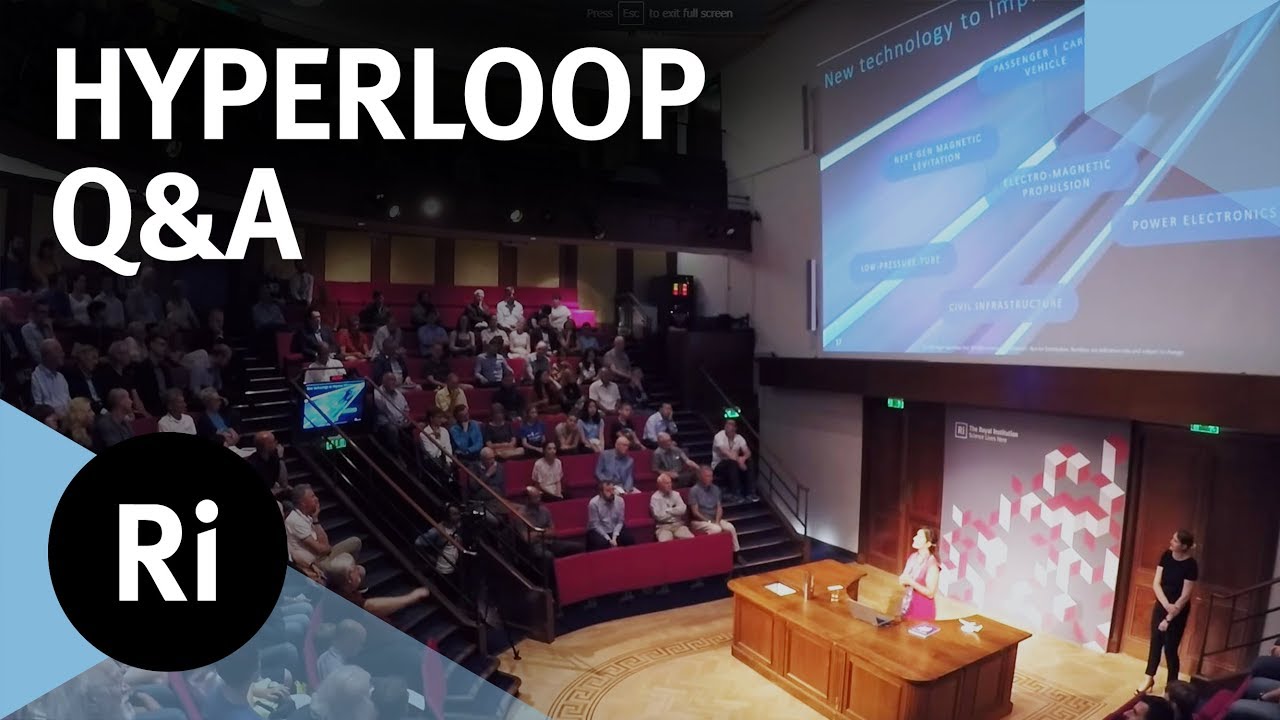
Dr. Anita Sengupta spent more than two decades solving problems that had never been solved before, first for NASA’s deepest space missions and now for a transportation system that doesn’t fully exist yet. In this Royal Institution Q&A, she takes audience questions on the practical engineering behind hyperloop — the proposed network of autonomous pods that levitate magnetically inside low-pressure tubes — after her main talk on the technology’s promise. The session moves quickly past the sales pitch and into the mechanics: pressure differentials, boarding logistics, and why the rail industry hasn’t simply adopted this approach already.
- Sengupta spent 16 years at NASA’s Jet Propulsion Laboratory, where she led development of the supersonic parachute system used to land the Curiosity rover on Mars in 2012.
- Her NASA résumé also includes ion propulsion work on the Dawn spacecraft’s journey to Vesta and Ceres, Orion capsule parachute testing, and managing the Cold Atom Laboratory aboard the International Space Station.
- She served as Senior Vice President of Systems Engineering at Virgin Hyperloop One from 2017 to mid-2019 while teaching astronautical engineering at the University of Southern California.
From Mars Landings to Ground Transport
Sengupta’s path to hyperloop didn’t start with trains. She built her career at Boeing Space Systems on the Delta IV launch vehicle before moving into NASA’s deep-space program, where her doctoral research on ion engine technology powered the Dawn spacecraft through the asteroid belt. She later took charge of the supersonic parachute system critical to getting Curiosity down onto the Martian surface, a piece of hardware with essentially one chance to work correctly. That same instinct for margin-of-error engineering — designing systems that must not fail because there’s no do-over — is what she brought when she moved from JPL into terrestrial transit, eventually running systems engineering for Virgin Hyperloop One while continuing to teach at USC.
Solving the Airlock Problem
The audience’s first hard question gets at the physical crux of hyperloop: how do you move a passenger from an ordinary, ambient-pressure train platform into a pod sealed inside a near-vacuum tube without killing the pressure seal every time a door opens? Sengupta walks through the airlock and boarding architecture designed to manage that differential, essentially treating station boarding the same way engineers treat spacecraft hatches — controlled staging chambers that equalize pressure before a pod ever enters the low-pressure tube network. It’s the same category of problem she’d already solved at JPL, just swapped from orbital mechanics to a station platform.
“We need to be bold, we need to take risks, and we need to innovate.”
Factors Delaying Rail Industry Innovation
The second recurring question in the Q&A is the more skeptical one: if vacuum-tube travel is so efficient, why haven’t existing high-speed rail systems or public infrastructure agencies already built it? Sengupta doesn’t dodge the answer. Maintaining a human-rated vacuum seal across miles of tube, at the capital cost required, runs into a regulatory pathway that doesn’t yet exist for this category of transport — meaning every safety verification has to be built essentially from scratch rather than adapted from existing rail code. That combination of upfront cost and unproven regulatory approval is, in her telling, the real barrier — not the physics.
Readers curious about the broader mechanics of the system Sengupta helped engineer can find a fuller technical breakdown in Hyperloop Explained | The B1M, while her NASA-to-transit career arc sits alongside other propulsion and orbital work covered in The next generation of space technology.
The Speed and Efficiency Case
On the numbers, Sengupta’s pitch is straightforward: air travel tops out around 600 miles per hour commercially, while hyperloop pods are designed to reach speeds up to 760 miles per hour by eliminating rolling friction and aerodynamic drag inside the low-pressure tube. Powered by electricity rather than jet fuel, and using magnetic levitation for a smooth, low-noise ride, the system is pitched as both faster and lighter on infrastructure footprint than the runways and fuel logistics air travel demands. Whether that pencils out at scale is exactly the kind of question the Q&A audience keeps circling back to — for readers tracking other proposed transit concepts, 10 Coolest New Methods of Transportation covers where hyperloop fits among the field.
Sengupta left Virgin Hyperloop One’s systems engineering role in mid-2019, right around when this session aired, having spent two years pushing the airlock and boarding questions from theory toward an actual build. The regulatory pathway she described as the real obstacle is still the one any operator will have to walk before a paying passenger ever steps into a pod.



New technology makes troops invisible
He built a monster machine! – Guinness World Records
Your Life, Brought to You by Video Games
The Try Guys Try 13 Future Technologies At Google
My Regrets as a Computer Science Student