

 InfoSearched
Physicists have spent seven decades chasing a star-powered answer to the world’s energy problem, and ITER is where that chase gets its biggest test yet.
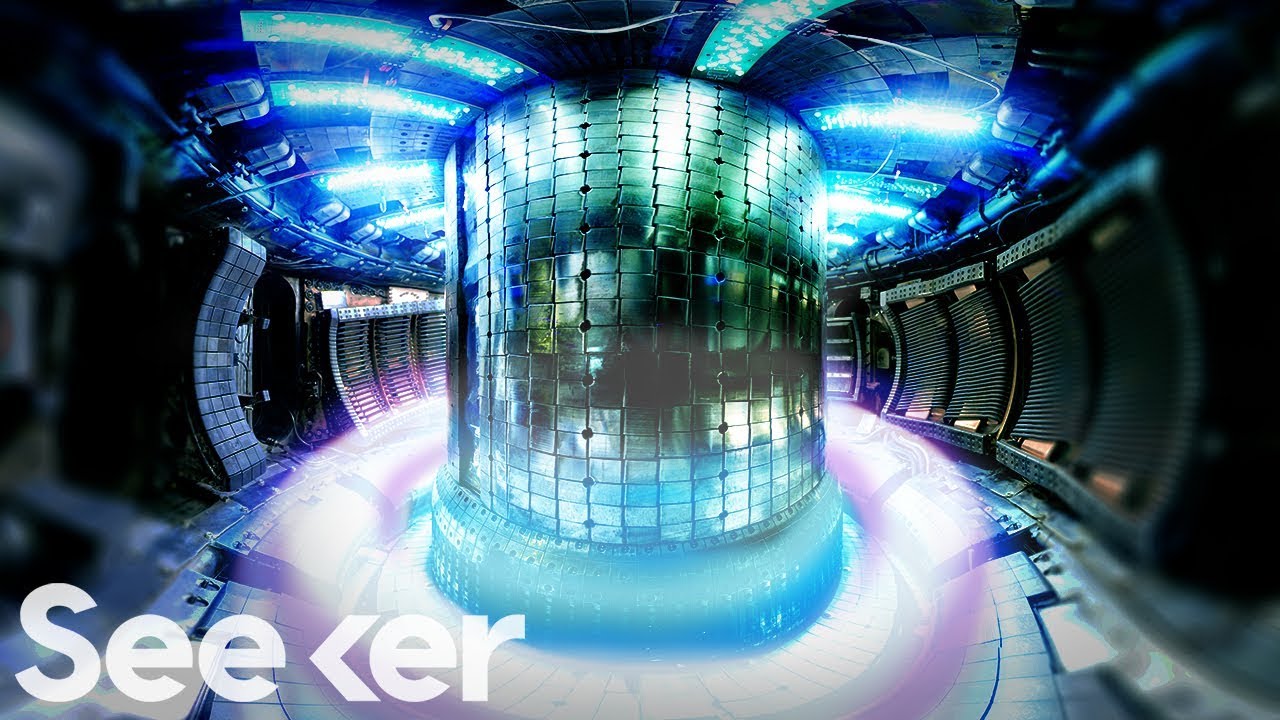
Seeker’s documentary “How Close Are We to Fusion Energy?” lays out exactly why fusion still isn’t lighting a single home, despite decades of promises that it would. The answer involves plasma hotter than anything in the solar system, magnets the size of buildings, and a 35-nation construction project in the south of France that won’t fire up for years. The video breaks down the physics, the hardware, and the private-sector scramble trying to beat the giant government reactors to the punch.
- ITER, under construction in Saint-Paul-lès-Durance, France, is backed by 35 nations — including the U.S., EU, China, Russia, India, Japan, and South Korea — and is designed to hit a power gain factor (Q) of 10.
- Fusion reactors need plasma heated to roughly 100 to 150 million degrees Celsius, about ten times hotter than the sun’s core, just to force deuterium and tritium nuclei to fuse.
- Private companies including General Fusion, Commonwealth Fusion Systems, and TAE Technologies are racing government megaprojects with smaller, faster approaches to net energy gain.
The Physics Problem at the Core
Fusion is the opposite of what commercial nuclear plants do today. Fission splits heavy nuclei apart and leaves behind waste that stays radioactive for thousands of years. Fusion slams light nuclei together — specifically the hydrogen isotopes deuterium and tritium — and releases energy the same way the sun does, just without a star’s crushing gravity to help. That’s the catch: without gravitational pressure, Earth-based reactors have to make up the difference with heat, cranking plasma up to 100 to 150 million degrees Celsius, roughly ten times hotter than the sun’s own core.
Hitting that temperature is one problem. Holding onto it is another. The documentary walks through why sustaining plasma long enough to reach net energy gain — producing more power than the reactor consumes — has eluded every experiment built so far. Plasma is unstable by nature, prone to turbulence that can dump heat into reactor walls faster than magnets can contain it, which is precisely the materials-science headache researchers still haven’t fully solved.
Tokamaks, Stellarators, and Laser Ignition
Two rival hardware philosophies dominate the field. Magnetic confinement fusion uses donut-shaped tokamaks and stellarators to bottle plasma inside superconducting magnetic fields, keeping the burning gas away from any physical wall. Germany’s Wendelstein 7-X, a stellarator, has already demonstrated the confinement approach on a smaller scale, giving researchers real-world data on how twisted magnetic fields behave under sustained plasma conditions.
The other path is inertial confinement fusion, where high-powered lasers compress a fuel pellet so violently it ignites. Lawrence Livermore National Laboratory’s National Ignition Facility in California runs the most advanced version of this approach, firing coordinated laser pulses at pellets in an attempt to trigger the same reaction tokamaks chase with magnets instead of light.
ITER and the Q10 Target
No single project carries more weight than ITER. Funded by a 35-nation consortium spanning the U.S., European Union, China, Russia, India, Japan, and South Korea, the reactor rising in Saint-Paul-lès-Durance is built to prove fusion can produce ten times more energy than it consumes — a Q factor of 10. That number matters because every prior tokamak has struggled to break even, let alone multiply its output tenfold.
Terrestrial fusion reactors need plasma roughly ten times hotter than the sun’s own core just to force deuterium and tritium to fuse.
ITER’s scale reflects the stakes and the difficulty. Getting there means solving tritium-breeding — since tritium is scarce and must be manufactured on-site — while also engineering materials that can survive years of neutron bombardment without degrading, a problem the nuclear power industry has wrestled with in different forms for decades.
The Private Fusion Race
Governments aren’t the only ones chasing Q10. General Fusion, Commonwealth Fusion Systems, and TAE Technologies represent a growing wave of venture-backed startups betting they can reach net energy gain faster and cheaper than a state-funded megaproject managed by 35 countries. Their pitch is speed: smaller reactors, tighter iteration cycles, and private capital that doesn’t need consensus from a multinational treaty body to change course.
Whether that bet pays off before ITER even finishes construction is the open question the documentary leaves hanging. Either way, the underlying appeal is the same one driving interest across the broader push for carbon-free power sources: a fuel source that produces no long-lived radioactive waste and, unlike solar or wind, doesn’t depend on the weather.
ITER isn’t scheduled to produce its first plasma until the 2020s, and full deuterium-tritium fusion runs sit even further out on the timeline. Nobody in the documentary claims fusion power is reaching a municipal grid anytime soon — the honest answer is still decades, not years — but the reactor going up in southern France is the closest thing the world has to a real test of whether Q10 is achievable outside a physics textbook.



Q&A: Hyperloop and the Future of Transport Technology – with Anita Sengupta
The danger of AI is weirder than you think
“This Could Be a Tragedy For Humanity” | The First Brain Chip Implant
The high-tech future of fashion
Beyond bionics: how the future of prosthetics is redefining humanity