

 InfoSearched
A land yacht just did something physicists insisted was impossible.
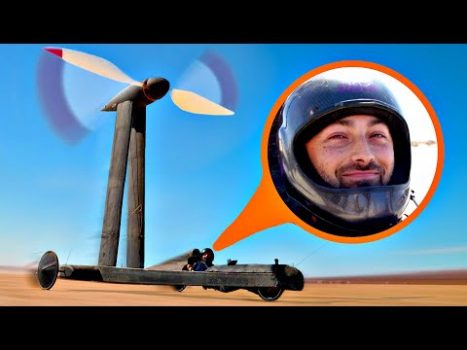
Derek Muller, host of the Veritasium YouTube channel, headed to a dry lake bed in California to put a decades-old argument to bed for good. Can a wind-powered vehicle travel directly downwind faster than the wind itself, with no engine and no external power source, without breaking the conservation of energy? Published May 29, 2021, “Risking My Life To Settle A Physics Debate” follows Muller as he climbs into the cockpit of a strange three-wheeled craft called Blackbird to find out.
- Muller tests Blackbird, a wind-powered land craft built in 2010 by engineer Rick Cavallaro, on the dry lake bed at El Mirage, California.
- University physics professors had long argued that directly downwind faster-than-the-wind (DWFTTW) travel was impossible, chalking up earlier claims to wind gusts or bad measurements.
- During the test runs with Cavallaro, Blackbird accelerates past true wind speed, confirmed visually when a forward-mounted streamer flips around and blows backward into the oncoming apparent wind.
A Debate That Physics Professors Wouldn’t Let Die
The idea of a wind-powered vehicle outrunning the wind that pushes it sounds like a contradiction, and for years plenty of credentialed physicists treated it as one. The objection was simple: if the wind is your only source of power, you can’t end up moving faster than the wind, because at that point the wind would be pushing backward relative to you rather than forward. Critics who watched earlier attempts at directly downwind faster-than-the-wind travel chalked the results up to gusts, sloppy timing, or measurement error rather than a genuine violation of what they assumed was settled physics.
Cavallaro built Blackbird in 2010 specifically to end the argument with hard data instead of another round of forum posts and chalkboard equations. Muller frames the trip to El Mirage as a chance to run the experiment himself, in person, with instrumentation that leaves no room for the “it was just a gust” excuse.
Blackbird Exploits Aerodynamic Principles
Blackbird’s trick isn’t magic, it’s mechanical. A tailwind pushes on the craft and gets it rolling, and that initial motion spins the wheels. Chains and gears take that wheel rotation and drive a large propeller mounted at the rear, spinning it like a fan that blows air backward off the back of the vehicle and generates forward thrust, independent of the ambient breeze.
The part that breaks people’s intuition is what happens once Blackbird approaches wind speed. Because the craft is riding the interface between two media moving at different relative speeds, the ground underneath and the air around it, the propeller keeps finding energy to extract even as it closes in on and then passes the wind’s own speed. Muller compares it to a sailboat tacking upwind, except here the propeller blades are continuously doing that tacking motion as they spin, pulling usable energy out of the difference between ground speed and wind speed rather than running out of push the moment the two speeds match.
Everyone will say this craft breaks the laws of physics.
Putting It to the Test at El Mirage
Out on the dry lake bed with Cavallaro, Muller takes the controls himself. The runs show Blackbird continuously accelerating past the true wind speed rather than topping out at it, and the proof isn’t just a number on a display. A streamer mounted at the front of the craft, which should stream backward with the wind under normal circumstances, instead reverses and blows forward into what is now the apparent headwind, a direct visual sign that Blackbird is outrunning the very wind that’s supposedly its only power source.
It’s the kind of vehicle that belongs alongside the other oddball machines built to test the edges of engineering rather than sell a product, in the same spirit as some of the stranger entries in 10 Most Unusual Vehicles. Cavallaro didn’t design Blackbird to go fast for its own sake; he designed it to force skeptics to watch the streamer flip with their own eyes.
Experimental Results Remain Valid
The conservation of energy isn’t actually in danger here, and that’s the point Muller keeps circling back to. Blackbird never exceeds the energy available in the wind; it just taps into a different reference frame than the ground-speed-versus-wind-speed intuition most people bring to the problem. The propeller is constantly extracting energy from the relative motion between the air and the ground, the same underlying principle that lets a sailboat’s keel and sail work together to sail faster than a following wind, just engineered into a three-wheeled land vehicle instead of a hull. Once you separate “faster than the wind” from “more energy than the wind provides,” the paradox dissolves.
Muller closes the video having done what years of Internet arguments couldn’t: put the craft on the clock, in the open, with a camera running and a streamer that doesn’t lie. Blackbird’s 2010 record attempts had already drawn some outside verification at the time, but this was Muller putting his own hands on the wheel at El Mirage and watching the apparent wind flip in real time, which is about as close as a physics argument gets to a mic-drop.







Working Mandalorian Helmet with HUD! – See 500 Feet In Total Darkness!
THE FIRST EVER HOVERBIKE IN THE WORLD
We’ve Found The Magic Frequency (This Will Revolutionize Our Future)
A DAY (NIGHT) in the LIFE of a NOC ENGINEER!
A beginner’s guide to quantum computing | Shohini Ghose