

 InfoSearched
Every diver’s photo comes out looking like it was shot through a blue-green filter — there’s finally a fix for that.
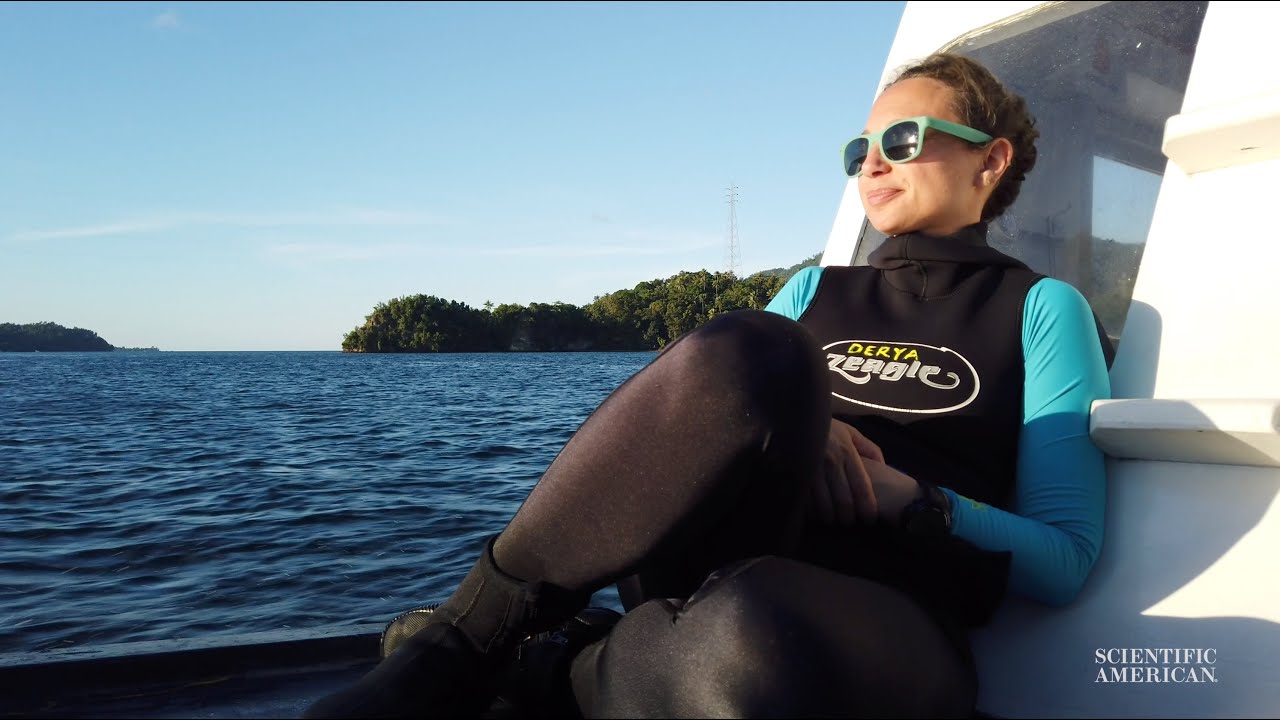
Derya Akkaynak spends her working life underwater, and for years she watched the same problem ruin otherwise perfect shots: reds vanish, yellows disappear, and everything drowns in a monochromatic blue-green haze. Working with University of Haifa researcher Tali Treibitz, the oceangoing engineer built an algorithm called Sea-thru that strips that haze out computationally, restoring underwater scenes to something close to their true colors. Scientific American featured the work in November 2019, with a video by Erik Olsen following Akkaynak diving in Indonesia’s Lembeh Strait to show exactly how the effect happens and how the fix works.
- Sea-thru was built by Derya Akkaynak and Tali Treibitz, based on a physically accurate image formation model the pair introduced at CVPR in 2018 and 2019.
- The algorithm uses RGBD (color plus depth/range) imagery, calculating backscatter from the darkest pixels and distance data to reverse light loss pixel by pixel.
- Unlike Photoshop-style edits that just boost warm tones uniformly, Sea-thru restores colors so automated systems can classify coral species and track marine populations without manual correction.
Causes of Underwater Blue Tint
Light doesn’t survive a trip through seawater intact. Longer wavelengths — reds and yellows — get absorbed first as light travels down through the water column, a phenomenon called spectral attenuation. What’s left by the time light bounces off a reef and back into a camera lens is mostly blue and green, plus a layer of backscatter from particles suspended in the water itself. The deeper the shot, the worse it gets, which is why so much footage from Lembeh Strait and reefs like it comes back looking like it was filmed through a dirty aquarium.
Limitations of Photoshop Filters
Divers have tried to fight this for decades with editing software, warming up an image by cranking the reds and yellows across the entire frame. The problem is that water doesn’t dim light uniformly — the correction needed for an object ten feet from the lens is completely different from the correction needed for something forty feet away. Akkaynak and Treibitz’s model treats that range-dependent falloff as the actual physics problem it is, rather than a color grade to eyeball.
Sea-thru calculates backscatter from the darkest pixels in a scene and estimates spatially varying illuminants to reverse the water’s effect pixel by pixel — not by guessing, but by measuring range.
Mechanism of Sea-thru Technology
The algorithm takes RGBD input — standard color data paired with depth or range information — and uses it to model exactly how much light was lost at every point in the frame based on distance from the camera. It calculates backscatter from the darkest pixels in the image, then estimates the illuminant at each depth to reconstruct what the scene would look like photographed through clear air rather than seawater. The output isn’t a stylized enhancement; it’s a corrected image built from the same physical model Akkaynak and Treibitz presented to the computer vision community at CVPR.
Beyond Prettier Photos
The real payoff isn’t aesthetic. Marine biologists and conservationists rely on computer vision and machine learning systems to sort through thousands of survey images — identifying coral species, counting fish populations, flagging bleaching events. Those classifiers are trained on color, and a blue-green wash throws them off. By handing algorithms color-accurate imagery instead of hazy blue frames, Sea-thru lets automated survey work run without researchers manually correcting every photo by hand first, the kind of grunt work that’s long slowed down large-scale reef monitoring.
Akkaynak’s dive footage from Lembeh Strait is the demonstration, but the target audience is anyone running a underwater survey camera rig — the fewer hours a marine biologist spends manually white-balancing thousands of frames, the more reef gets actually studied. That’s the trade Sea-thru is selling: less darkroom work, more usable data coming back from every dive.





Hyperloop Explained | The B1M
Futuristic Technology You Can Buy Today
We’ve Found The Magic Frequency (This Will Revolutionize Our Future)
Making a DRIVETRAIN and Installing the Micro V4 ENGINE on the RC Car!
AMAZING TECHNOLOGIES OF THE FUTURE